Most flooring problems are not material problems. They are installation problems. Hollow-sounding planks, joints that separate after a year, a floor that stops two millimetres short of the skirting, a warranty nobody will honour. All of it traces back to who laid the floor and what the quote actually covered.
These eight tips for choosing a flooring contractor cover what to look for before you sign, and the warning signs worth walking away from.
What A Flooring Contractor Actually Does

A flooring contractor supplies the material, prepares the subfloor, installs the floor and handles repairs afterwards. An interior designer coordinates a whole renovation and subcontracts the flooring to someone else.
For a floor-only job, going straight to a flooring specialist is usually faster and cheaper, and it keeps one team accountable for both the subfloor and the finish. That accountability is the whole point. When different parties handle the base and the surface, problems become someone else’s fault.
Tips For Choosing A Flooring Contractor In Singapore
Check whether the installers are in-house or subcontracted, ask for an itemised quote that includes subfloor levelling, and confirm what the workmanship warranty covers, not just the material. Then review recent projects, real photos, and the payment schedule before committing.
Tip 1: Find out if the installers are in-house
Many suppliers sell the material and hand the installation to a freelance crew they have no ongoing relationship with. That crew has no stake in the outcome. If the floor sounds hollow in six months, you are back with the supplier, who points at the installer, who has moved on.
Find out whether the company’s own team will lay your floor. A good answer names the team, explains how long they have worked together, and puts one company’s name on both the supply and the installation.
Tip 2: Check registration and insurance
Make sure the company is a registered entity, not an individual trading informally. Public liability insurance matters too, since it covers damage to your property or a neighbour’s during the job.
Condos and MCSTs often require proof of insurance before granting renovation access. A contractor who has done this work before will produce it without hesitation.
Tip 3: Look at real past work, not stock photos
Manufacturer renders look beautiful and prove nothing. What you want is real installations from the last few months: a finished HDB living room, a condo with the skirting in place, a shop floor.
Look at the edges. Anyone can photograph the middle of a room. Quality shows at the thresholds, around door frames, at the skirting line, and where the floor meets a different material. Sloppy transitions are the most common sign of a rushed job.
Tip 4: Read the reviews properly
A high rating can mean less than the reviews actually say. Look for specifics: punctuality, how the team handled an uneven subfloor, whether they cleaned up, what happened when something went wrong.
Read the recent ones first. A company can coast on reviews from three years ago while its current crew turns over. It is also worth seeing how the company replies to criticism, since that tells you what after-sales will be like.
Tip 5: Insist on an itemised quote that includes levelling
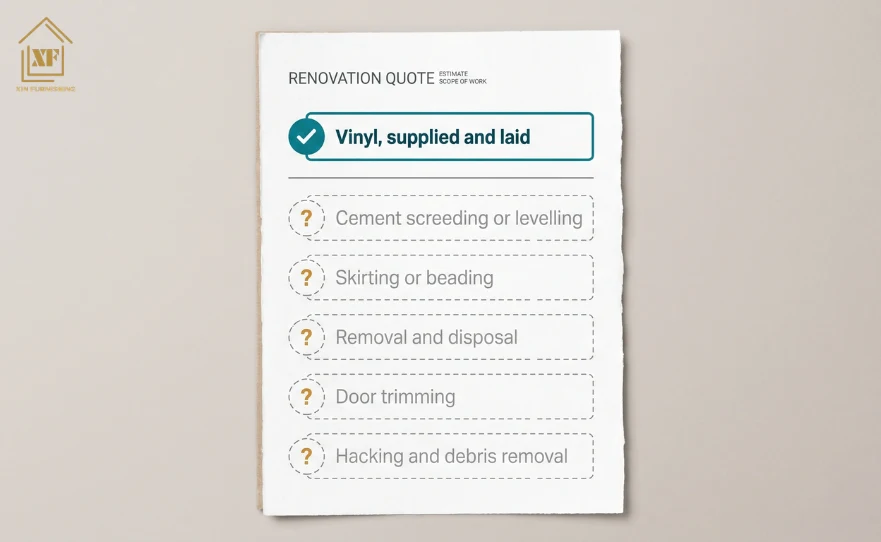
A price per square foot is not a quote. These five items are commonly left out, and they are where budgets break:
- Cement screeding or self-levelling, if the subfloor is uneven
- Skirting or beading
- Removal and disposal of the old flooring
- Door trimming, where the new floor height needs clearance
- Hacking and debris removal, if you are tiling rather than overlaying
Levelling is the big one. A contractor who has not assessed your subfloor cannot price the job honestly, which means the number will change once work starts.
Typical vinyl supply-and-install prices in Singapore run from about S$3.5 to S$7.00 per square foot, and our vinyl flooring cost guide breaks down each line.
Tip 6: Confirm who handles HDB and building approvals
Renovation work in an HDB flat has to follow rules on permits and approved works. Check the current HDB renovation guidelines for your specific job, and expect a competent contractor to walk you through them rather than leave it with you.
For condos, the management office sets renovation hours, lift-protection requirements and access rules. A contractor who works in condos regularly will know what your MCST needs before you ask.
Laying vinyl over existing tiles avoids hacking entirely, which makes the approval process considerably simpler. Our guide covers installing vinyl over existing tiles and when the tiles are suitable.
Tip 7: Check the warranty terms, and what voids them
Two separate things matter here.
The material warranty covers manufacturing defects in the plank, and usually comes from the manufacturer.

The workmanship warranty covers the installation: lifting planks, separating joints, and installing on a floor that was never level. This is the one homeowners forget about, and the one that actually matters.
Find out what voids it too. Steam mops, water damage from standing water, and moving heavy furniture without protection are common exclusions.
Tip 8: Agree on the payment schedule in writing
A reasonable structure is a deposit on confirmation and the balance on completion, after you have inspected the floor.
Walk away from anyone who demands full payment upfront. Once a contractor holds all your money, you have no leverage if something goes wrong. Get the schedule in writing, along with the timeline and what happens if the job runs over.
Red Flags: When To Walk Away
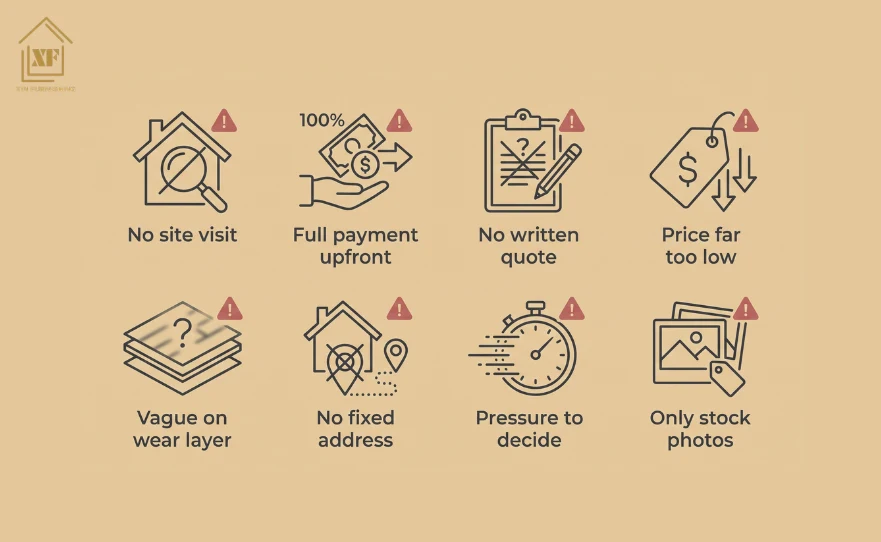
- The quote arrives without a site visit. Nobody can price levelling from a photo.
- They demand full payment upfront, or an unusually large deposit.
- No written quote, just a figure over WhatsApp.
- A price far below everyone else. Something has been excluded, usually the levelling or the wear layer.
- Vague answers on the wear layer. A supplier who will not give you a figure in millimetres is hiding one.
- No fixed address or showroom.
- Pressure to decide today, with a discount that expires this evening.
- Reluctance to show recent work, or only manufacturer renders.
What to ask a flooring contractor AT Site measurement

Looking for a vinyl flooring contractor in Singapore?
Xin Furnishing is a direct supplier and vinyl flooring contractor in Singapore, with in-house installation and levelling crews covering HDB flats, condos, landed homes and commercial spaces.
WhatsApp +65 9690 2060 for a free site measurement, or visit the showroom at 101 Woodlands Avenue 12, #01-02, Singapore 737719.
Frequently Asked Questions
How do I know if a flooring contractor is reliable?
Look for in-house installers, an itemised quote that includes levelling, and a warranty that covers workmanship and not just the material. Then read recent reviews for specifics about how the team handled problems.
Should I use a flooring contractor or an interior designer?
For a floor-only job, go straight to a flooring specialist. It is usually faster and cheaper, and one team stays accountable for both the subfloor and the finish. An ID makes more sense when you are renovating the whole home.
How much deposit is normal?
A deposit on confirmation with the balance on completion is standard. Never pay in full before the work is done.
What should a flooring quote include?
Materials, labour, subfloor preparation and levelling, delivery, removal and disposal of the old floor, skirting, and door trimming where needed. Ask for it itemised so you can compare quotes properly.
Do I need a permit to change my flooring in an HDB flat?
It depends on the works involved. Overlaying vinyl over existing tiles avoids hacking and is far simpler than a full replacement. Check the current HDB renovation rules for your specific job, and ask your contractor to confirm what applies.
How do I compare two quotes that look very different?
Compare line by line, not by the total. The cheaper quote usually excludes levelling, uses a thinner wear layer, or subcontracts the installation. Our guide on judging vinyl flooring quality covers what to compare.