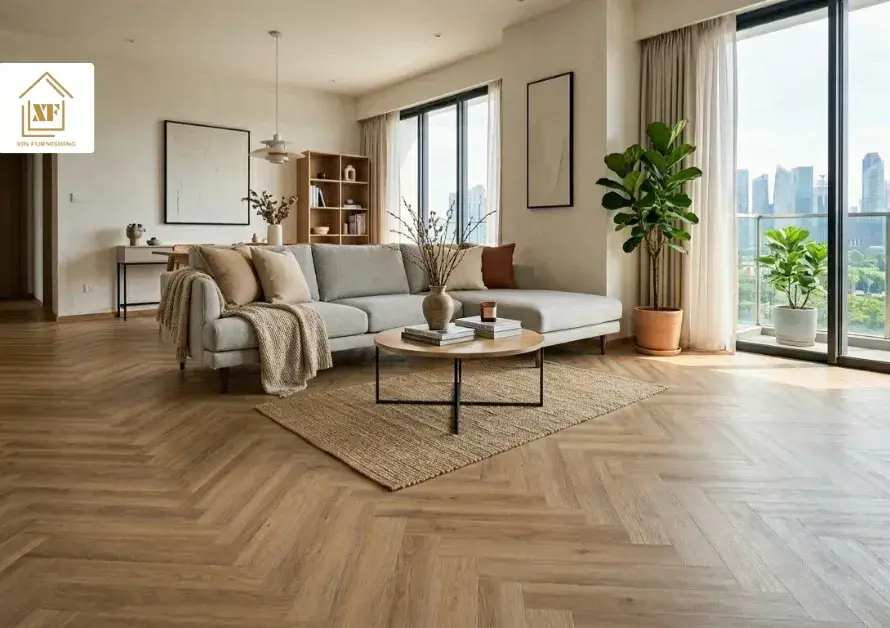
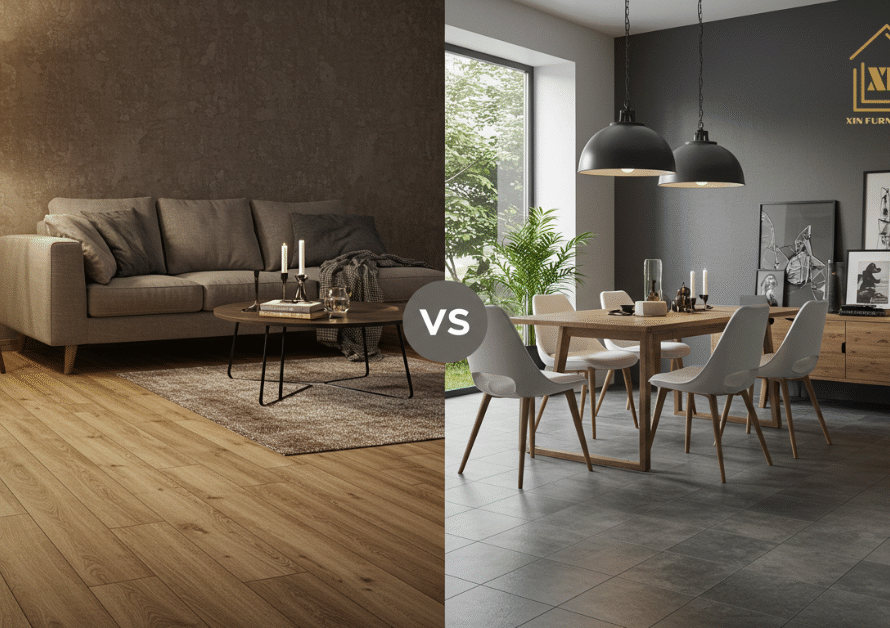
Two planks sit side by side in a showroom. Same wood grain, same finish, same feel underfoot. One costs forty per cent more.
Almost nothing you can see explains the difference. The specification does, and most of it never reaches the sales floor unless you ask.
Determine The Quality Of Vinyl Flooring: Important Factors
Ask for the wear layer in millimetres. Treat 0.5 mm as your minimum for a home you plan to stay in.
That single figure decides more than everything else combined. The rest of this guide covers what else to check, and which sample tests are worth doing.
The Wear Layer: The One Quality Indicator That Matters
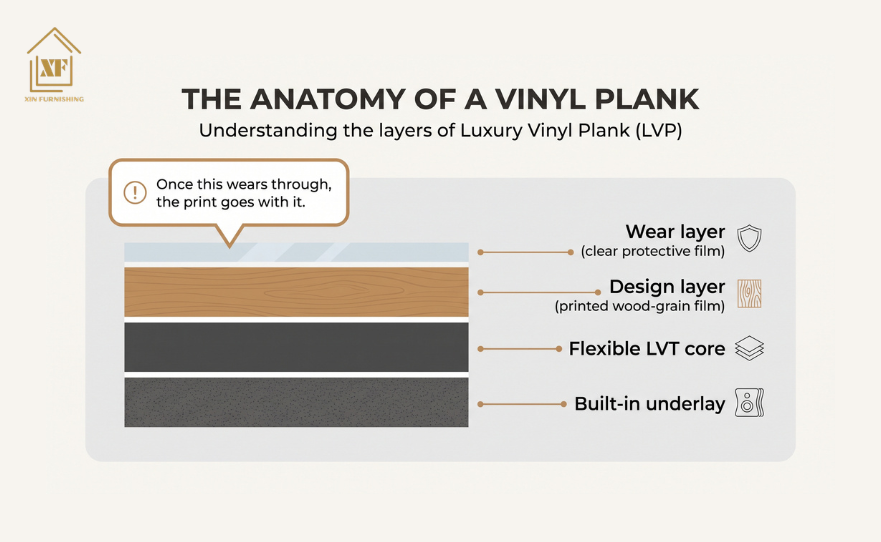
The wear layer is the clear protective film on top of the plank. It takes every footstep, every dragged chair, and every grain of grit tracked in from outside.
Beneath it sits the design layer, which is a printed film. Once the wear layer goes, the print goes with it, and no cleaning or polishing brings it back.
0.3 mm is frequently sold as standard residential grade. It is fine in a bedroom. In a hallway or living room, it shows traffic paths far sooner than people expect.
Ask by specification number, not by tier name. A floor described as premium with a 0.2 mm wear layer isn’t premium. Brand tiers are marketing; millimetres are not. Get the figure in writing, and if a supplier will not give it, that is your answer.
Our guide covers how long vinyl flooring lasts at each thickness.
Wear Layer In Mils Vs Millimetres: How To Convert
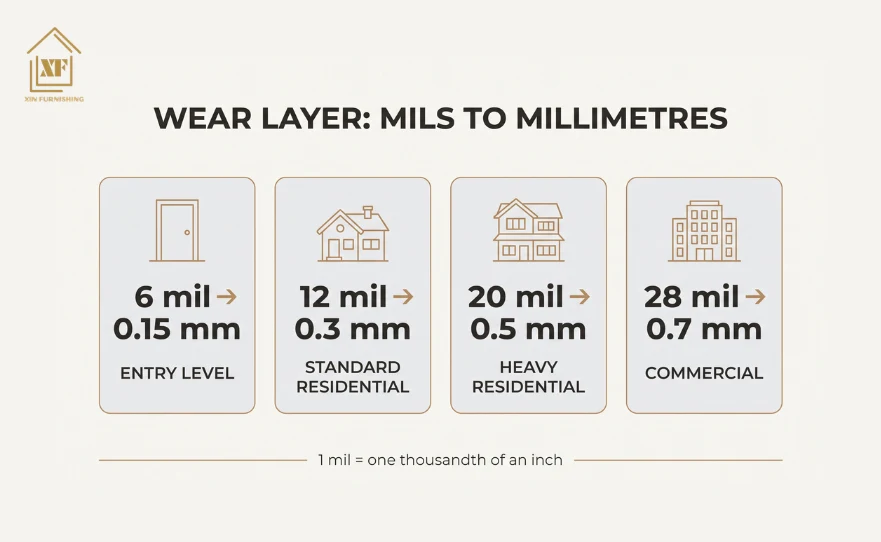
American listings measure wear layers in mils, which is one thousandth of an inch. Singapore and European products use millimetres. Most buyers researching online hit both and have no way to compare.
A US guide recommends 20 mil, which is the same 0.5 mm we specify as standard.
Why AC Ratings Are Not A Vinyl Quality Rating
You will see AC3, AC4, and AC5 quoted on vinyl products and in guides that discuss them. The AC scale is an abrasion class standard for laminate. It is not a vinyl specification.
Some suppliers quote it anyway, either out of habit or because it sounds like a quality signal. If a product sheet gives you an AC rating but no wear-layer figure, ask again for the wear layer. The AC number tells you nothing about how long a vinyl floor will last.
Six More Specifications That Signal Quality
Total thickness
Most residential vinyl is 4 to 6.5 mm thick. Thicker planks feel more solid, handle slightly uneven subfloors better, and often include a built-in underlay that reduces footstep noise. They also add height at doorways, which matters when overlaying existing tiles.
Thickness and wear layer are separate measurements. A 6 mm plank with a 0.3 mm wear layer wears through before a 4 mm plank with a 0.5 mm wear layer.
The click system
A named mechanical system, such as Unilin 2G, holds joints tighter and longer than a generic profile. Loose joints collect dirt and let water reach the subfloor. Ask which system a product uses, and be wary of answers like “standard click”.
Edge treatment
Micro-bevelled edges read as individual planks and disguise minor height variation between pieces. Square edges look flatter and show any unevenness more clearly.
Pattern repeat
Cheap prints repeat every few planks, and once you spot the same knot three times in a row you cannot unsee it. Ask how many unique faces a design has. Better products carry eight or more.
Embossed-in-register texture
On good products, the surface texture aligns with the printed grain, so what you feel matches what you see. On cheaper ones, a generic embossing runs underneath an unrelated print.
Dimensional stability
Some manufacturers publish a figure for how much a product moves with temperature. In a climate where rooms swing between air-conditioning and afternoon heat, it’s fair to ask, though few suppliers will have it to hand.
Vinyl Flooring Certifications Worth Checking
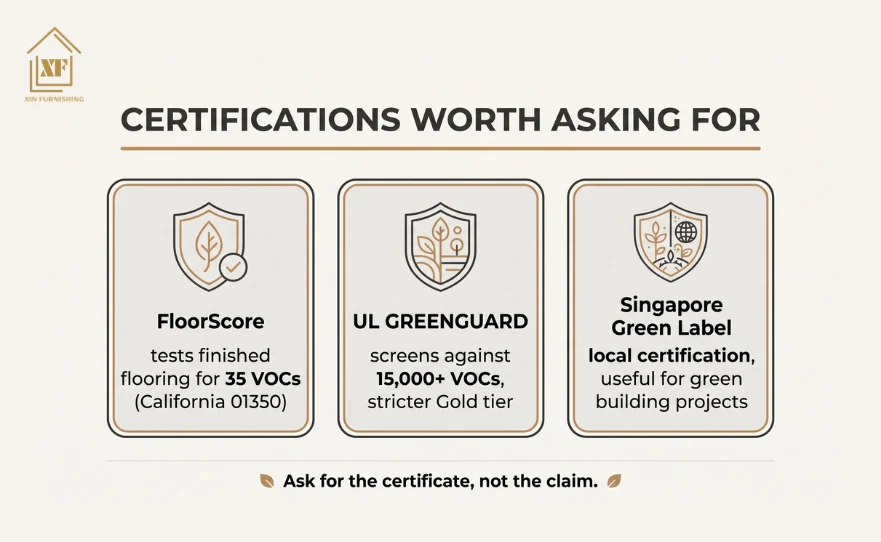
“Quality marks” on a brochure prove nothing. Three are worth asking about by name.
FloorScore tests finished flooring for 35 individual volatile organic compounds under the California 01350 standard. It is the most common flooring-specific emissions certification.
UL GREENGUARD screens certified products against more than 15,000 VOCs, with a stricter Gold tier that also meets California 01350.
Singapore Green Label, administered locally, is also worth asking about, particularly if you are specifying for a project with green building requirements.
Ask for the certificate rather than the claim. Any supplier holding one can produce it in a minute.
Four Quality Tests To Do On A Sample At Home
Take samples home. Showroom lighting flatters everything.
- Flex it: Gently bend the plank. Good vinyl flexes and returns without cracking or whitening along the fold. Stress whitening on a gentle bend suggests poor plasticisers.
- Press it: Press a fingernail firmly into the surface, then release. It should recover rather than hold the impression. Poor indentation recovery means every furniture leg leaves a permanent mark.
- Check the edges for delamination: Look closely at the sample’s cut edge. The layers should be fused with no visible separation or gap between the wear layer and the print.
- Look at it in your own light: Put the sample on the actual floor, in the actual room, and check it in the morning and at night. Colour reads differently under showroom LEDs than under afternoon sun.
- Two tests not worth doing: Scratching with a coin ruins the sample and tells you little, since all vinyl marks under metal. Dripping water tells you less, because all vinyl is non-porous, and the cheapest plank beads exactly like the best.
What Good Quality Vinyl Flooring Costs
It is the best-value upgrade on a flooring quote, and the one most often downgraded quietly to hit a price. A quote noticeably below everyone else has usually saved money somewhere, and the wear layer is the easiest place to do it invisibly.
Most of the price difference between two vinyl floors comes from the middleman, not the floor itself. Buying from a direct vinyl flooring supplier in Singapore cuts out that markup, so more of your budget goes into a thicker wear layer and a better finish.
Our vinyl flooring cost guide breaks down where the money goes.
Eight Questions To Ask Before You Buy
Take these to the showroom:
- What is the wear layer, in millimetres?
- What is the total thickness?
- Which click system does it use?
- How many unique plank faces does this design have?
- Does it carry FloorScore, GREENGUARD or Singapore Green Label?
- What does the warranty cover, and what voids it?
- Is installation in-house or subcontracted?
- Can I take samples home?
A supplier who answers all eight without hesitating is selling a specified product. One who deflects to brand tiers and finishes is selling a price.
Our guide covers choosing a flooring contractor in full.
Frequently Asked Questions
What wear layer should I buy for a Singapore home?
0.5 mm for living areas, hallways and kitchens. 0.3 mm is acceptable in bedrooms and spare rooms. Below 0.2 mm, expect visible scratching within two to three years of normal use.
Does a thicker plank mean better quality?
No. Total thickness affects comfort, sound and how well the floor sits on an uneven subfloor. It says nothing about how long the surface lasts.
Why do two planks that look identical cost so differently?
Usually the wear layer, the click system and the number of unique faces in the design. None of the three is visible in a single showroom-floor sample.
Is an AC rating a sign of quality in vinyl?
No. AC ratings belong to laminate. If a vinyl product sheet quotes one, ask for the wear layer thickness instead.
Can I tell quality by brand alone?
Not reliably. Most brands sell across several tiers, and the same name covers a 0.2 mm product and a 0.55 mm one. Ask for the exact product specifications you’re being quoted.
What does a good warranty tell me?
That the manufacturer is confident, but not how long the floor will look new. Warranties cover manufacturing defects, not wear. Read the exclusions, which typically rule out solvents, abrasives and steam.
Should I worry about VOCs?
Ask if your home is enclosed and air-conditioned most of the day, or if you have young children. A certified product gives you a verifiable answer, not reassurance.
Is more expensive always better?
No, but noticeably cheaper almost always means something was removed. Compare specifications line by line rather than totals.