Most people get a shock somewhere in the flooring process, and it is rarely the plank price. It is the line underneath it.
This guide covers what vinyl flooring actually costs in Singapore in 2026, what a per-square-foot rate does and does not include, and the subfloor preparation that most quotes leave out until the job has already started.
Cost Of Vinyl Flooring In Singapore At Each Price Level
Supplied and installed, vinyl flooring in Singapore typically costs S$3.50 to S$8.00 per square foot. A standard 4-room HDB flat works out to roughly S$3,000 to S$5,500 for the flooring itself.
Budget separately for subfloor preparation. On a bare BTO slab, screeding and self-levelling add S$1,200 to S$2,200, depending on flat size.
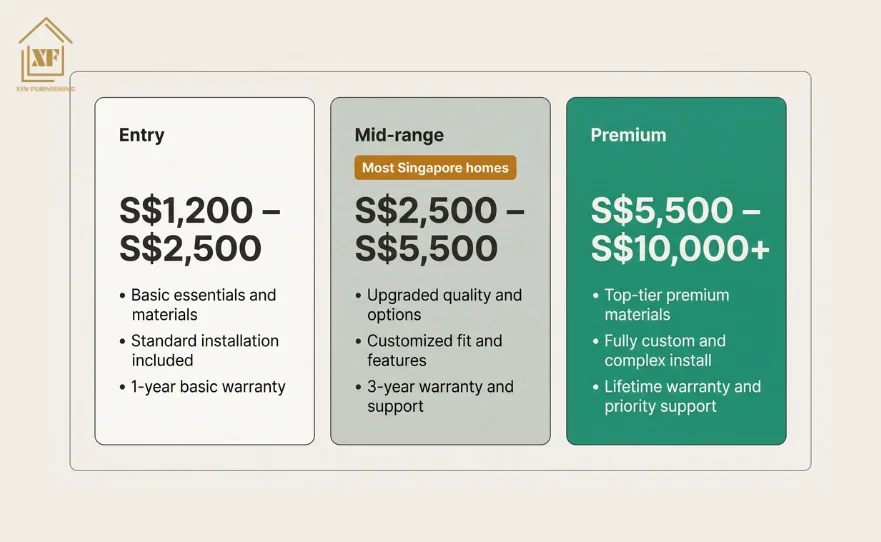
Most Singapore homes land in the mid-range. The jump from entry to mid-range buys you wear layer thickness, which is the single thing that decides how the floor looks in five years. Our guide covers how to judge vinyl plank quality before you compare prices.
What It Costs For Your Home
Approximate installed cost for the flooring only, at mid-range pricing. Add subfloor preparation separately.
These assume the whole unit excluding bathrooms, which stay tiled. Most homes also exclude the bomb shelter and sometimes the service yard, which brings the figure down.
Materials Versus Labour: What You Are Paying For
A per-square-foot price bundles two things that move independently.
Materials make up the larger share, and the figure rises with wear-layer thickness, plank thickness, and whether you build in an underlay.
Labour makes up the rest, and it is broadly flat for a straightforward overlay. Pattern work costs more, because herringbone and chevron layouts take longer to lay and waste more material.
This is why a very low all-in rate is worth questioning. Once you account for labour, little is left for the plank itself.
Commercial And Office Pricing
Shops, cafés and offices need a heavier specification for the traffic, which typically runs S$6.00 to S$12.00 per square foot installed.
Commercial jobs also carry costs homes do not: out-of-hours installation, lift protection, building management deposits and faster turnarounds. Our guide to commercial vinyl flooring covers the specification side.
What Changes The Price Per Square Foot
Four things move the rate more than anything else.
Wear layer thickness
Going from a thin wear layer to a thicker one adds to the rate, and that difference decides how the floor looks after five years. It is the best money you will spend on a floor.
Plank thickness and built-in underlay
Thicker planks with an underlay already bonded to them cost more per square foot, but they cut footstep noise and feel more solid underfoot. In a high-rise flat, that usually justifies the difference.
Pattern and layout
A straight lay is the baseline. Herringbone and chevron add noticeably to the rate, through both slower installation and more offcuts.
Area size
Larger jobs almost always price better per square foot. Site setup, crew mobilisation and delivery are broadly fixed, so spreading them across a whole flat costs less per square foot than across one bedroom.
Subfloor Preparation: The Cost Most Quotes Leave Out
This is where flooring budgets break.
If you are laying over existing tiles that are sound and reasonably level, preparation is minimal. That’s common in a resale flat or condo, which is why overlay is the standard approach here.
If you are starting from a bare slab, or the existing floor is uneven, you must build up or flatten the subfloor first.
Typical Singapore screeding and self-levelling packages for a bare BTO slab:
Proper packages include HDB-approved screed, haulage and disposal, and the HDB permit where one is required.
Screeding and self-levelling are not the same thing, and you may see both on one quote:
- Cement screeding lays a cement-sand layer over the slab to build height and correct level. This is what a bare BTO needs, particularly to level up to the entrance height.
- Self-levelling is a flowable compound that smooths the surface to a fine tolerance before the floor goes down.
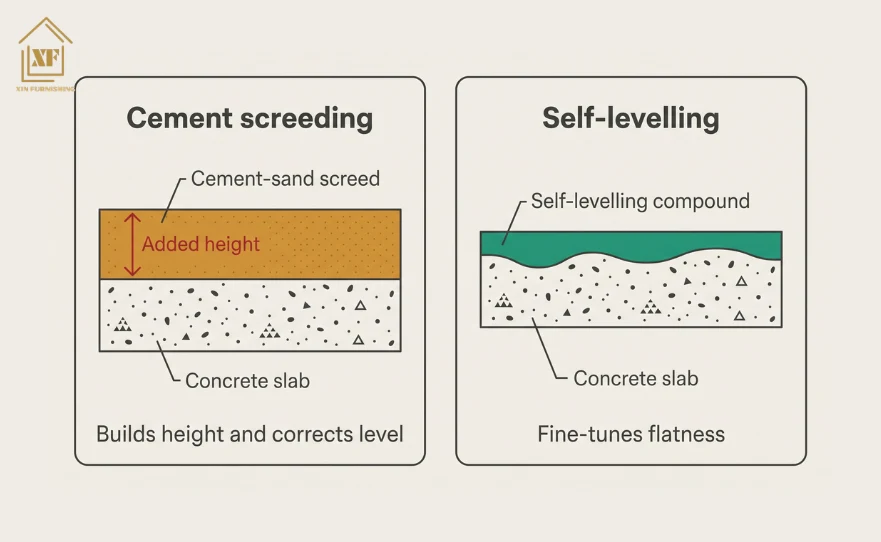
A bare slab usually needs both. An existing floor with minor unevenness often needs only self-levelling. A sound tiled floor needs neither.
The Other Costs Quoted Separately
Four more line items that rarely appear in a headline price:
- Skirting or beading, to cover the expansion gap at the walls
- Removal and disposal of the old flooring, if any
- Door trimming, where the new floor height needs clearance
- Hacking and debris removal, if you are removing tiles rather than laying over them
Ask for all of these in writing before you compare two quotes. A price that looks low per square foot often excludes two or three of them.
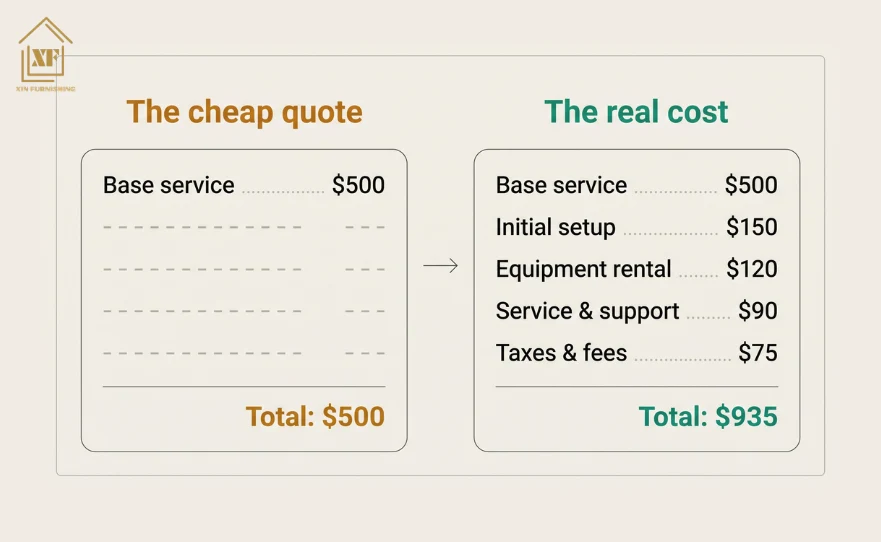
What Makes One Quote Cheaper Than Another
Four things, and only one of them is a bargain.
A thinner wear layer
Identical in a showroom, visibly different after two years in a hallway. This is the most common way a quote gets cheap.
Levelling excluded
The price is real until the installer arrives, finds the slab out of tolerance, and quotes the levelling as a variation. By then you have no leverage.
Subcontracted installation
The supplier sells the plank and hands the job to a freelance crew. If a joint lifts in year two, nobody owns it.
Genuine scale
A direct supplier importing in volume with in-house crews really can charge less than a retailer with a showroom chain and subcontractors. This is the one honest reason a price is lower.
A Worked Example: 4-Room HDB Flat
860 sq ft, resale flat, laying over existing tiles. Mid-range specification.
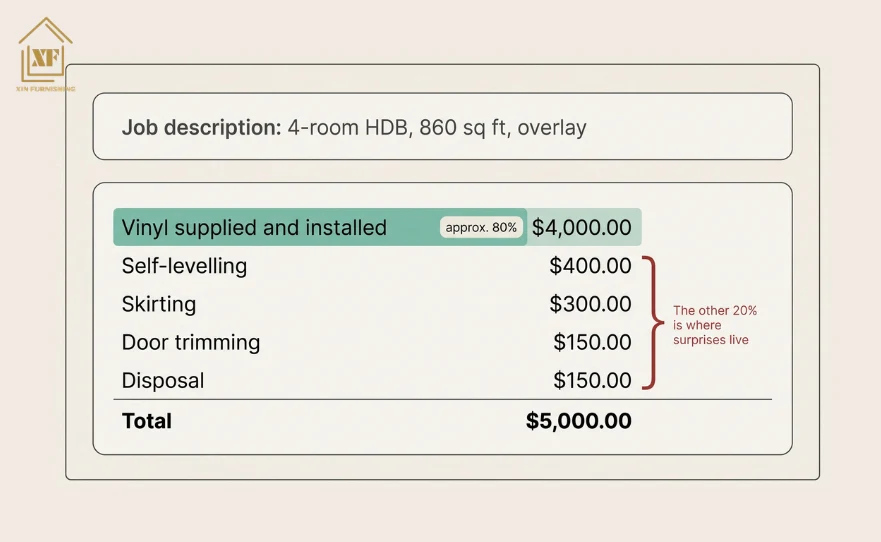
The same flat starting from a bare BTO slab would add roughly S$1,800 for screeding and self-levelling, bringing it to around S$6,700.
Your numbers will differ. The point is the shape of the quote: the plank is about 80%, and the remaining 20% is where surprises live.
How To Work Out Your Own Total
Take the per-square-foot rate from a quote and apply it to your actual floor area, not your flat’s stated size.
- Start with your floor area, then subtract the rooms that will not be done: bathrooms, usually the bomb shelter, and often the service yard.
- Add about 5% for wastage. Offcuts are unavoidable, and a herringbone or diagonal layout wastes more.
- Multiply by the rate for the flooring itself.
- Add separate line items for levelling where needed, skirting, disposal, and door trimming.
Step 4 is where most people’s estimate falls short. The rate covers the floor, not the job.
Get An All-In Quote For Your Own Flat
The only price that matters is the one for your floor, after someone has seen your subfloor.
Xin Furnishing quotes the full job after a site measurement, including levelling, so there are no variations once work starts. Our crews are in-house, every plank carries a 0.5 mm wear layer, and the floor comes with a 15-year residential warranty.
WhatsApp +65 9690 2060 for a free site measurement, or visit the showroom at 101 Woodlands Avenue 12, #01-02, Singapore 737719.
Frequently Asked Questions
How much does vinyl flooring cost for a 4-room HDB flat?
Roughly S$3,000 to S$5,500 for the flooring, supplied and installed, over existing tiles. Add around S$1,800 if you are starting from a bare BTO slab and need screeding.
How much is vinyl flooring per square foot, installed?
Most Singapore homes pay a mid-range rate of S$4.00 to S$7.00 per square foot, covering a 0.5 mm wear layer and in-house installation. Entry rates are lower, usually with a thinner wear layer. Premium rates run higher for thicker planks and pattern work.
Does the quoted rate include everything?
Rarely. A per-square-foot rate normally covers the plank and the labour to lay it. Levelling, skirting, disposal and door trimming are usually separate, which is why two quotes at the same rate can produce very different totals.
Is vinyl flooring cheaper than tiles?
Yes, usually by a wide margin. Vinyl runs S$3.50 to S$8.00 per square foot installed compared with S$6.00 to S$12.00 for tile, and it avoids the hacking and disposal costs that come with tiling.
Why do vinyl flooring quotes vary so much?
Wear layer thickness, whether levelling is included, and whether installation is in-house or subcontracted. Two quotes at very different prices are rarely for the same job.
Do I need to pay for screeding?
Only if you are starting from a bare slab or your existing floor is out of tolerance. Over sound, level tiles, you usually need neither screeding nor self-levelling.
Does a bigger area cost less per square foot?
Usually, yes. Fixed costs like site setup and crew mobilisation spread across more area, so a whole-flat job generally costs less per square foot than a single room.