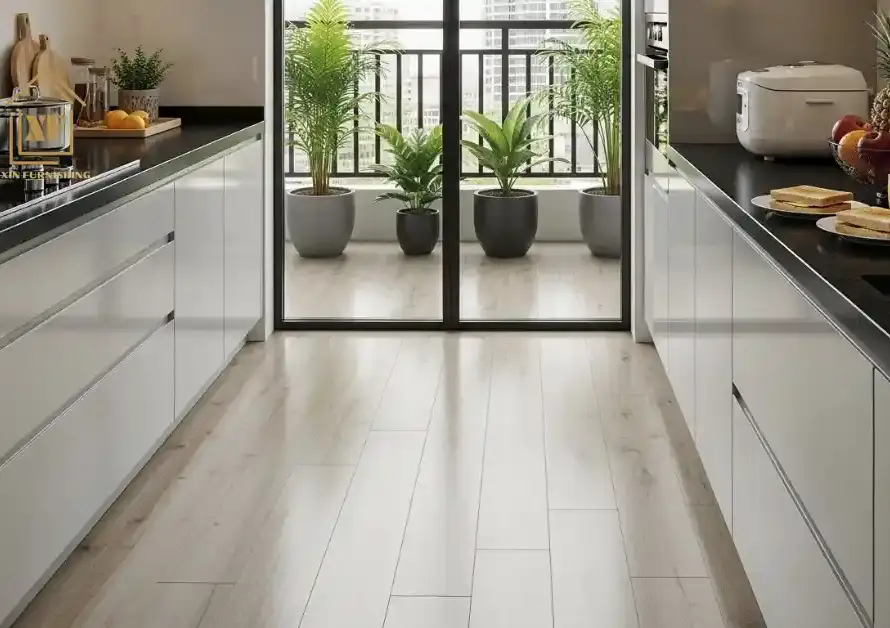
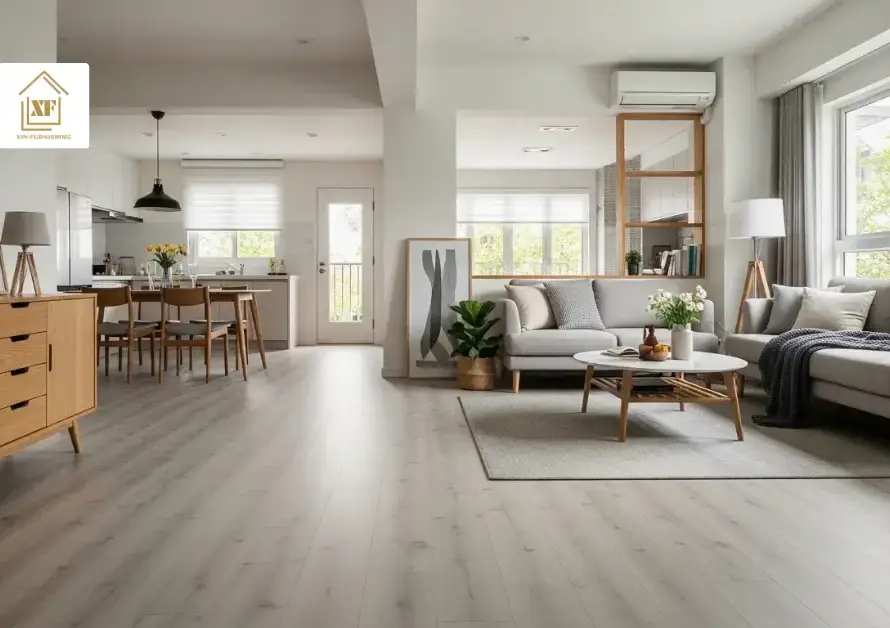
Herringbone turns a floor into a feature. That is the point, and also why it doesn’t belong in every room.
This guide to herringbone vinyl flooring Singapore homeowners can use covers what separates herringbone from chevron, which rooms it actually suits, which way it should run, and where the extra cost comes from.
What is herringbone flooring?
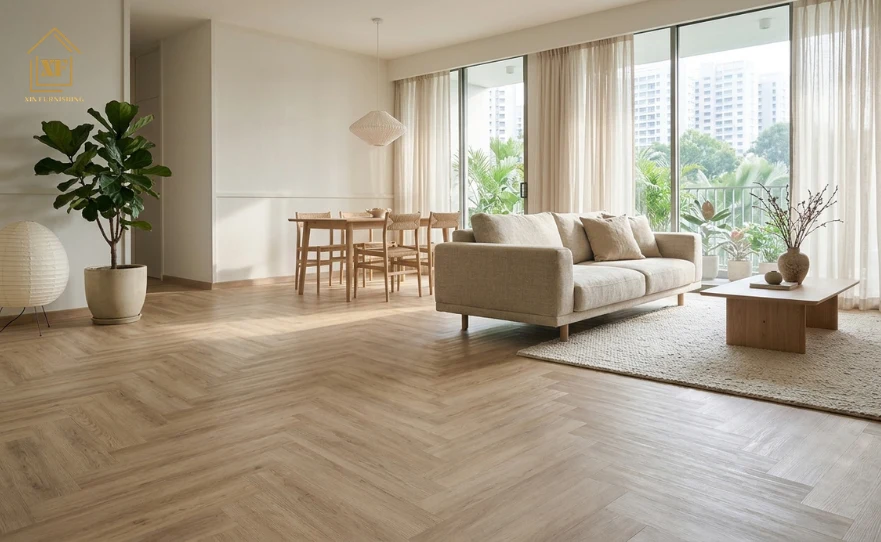
Rectangular planks laid at right angles to each other, forming a repeating zig-zag. Each plank meets its neighbour at 90 degrees, with staggered ends rather than aligned ones.
Traditionally, it was solid parquet, which is why it reads as expensive. Vinyl reproduces the pattern at a fraction of the cost, without the humidity problems that make real timber parquet difficult in a Singapore flat.
Herringbone vs chevron: the difference that matters
These get confused constantly, and they are not variations on a theme.
The simplest way to tell them apart: look at where two planks meet in the centre. If they form a clean continuous point, it is chevron. If one plank butts into the side of another, it is herringbone.
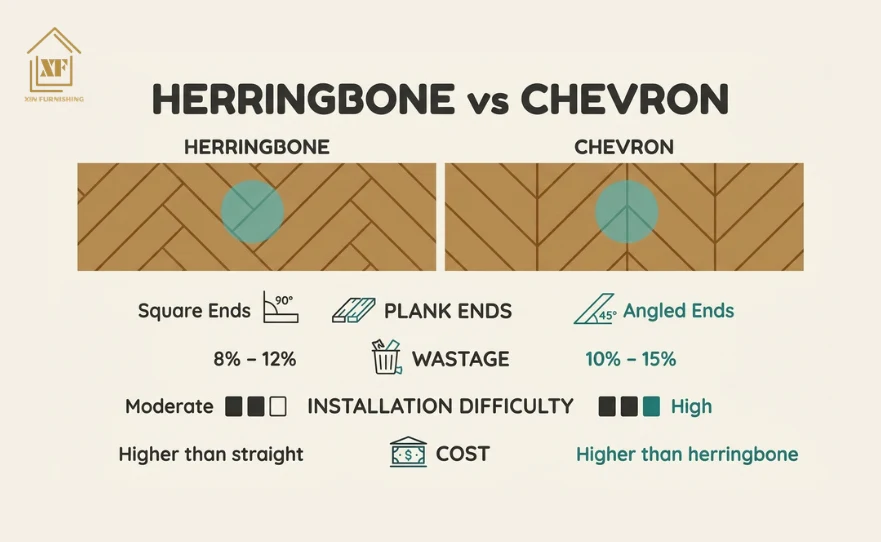
Which to choose: Specify chevron where the direction is doing work: a long hallway, a room you want to stretch, a scheme where the floor is meant to be read as a designed surface rather than a background. Herringbone is the more forgiving of the two; it is more widely stocked, and it suits a wider range of interiors.
For most Singapore homes, herringbone. Chevron is a stronger statement and a less forgiving installation.
Does herringbone suit your room?
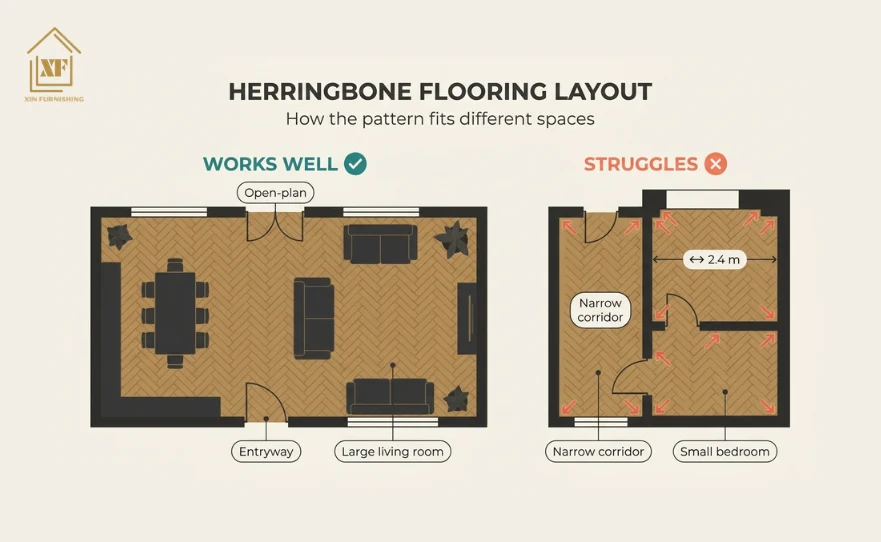
Most guides skip this question, and the answer isn’t always yes.
Herringbone needs scale to work. The pattern needs enough width to establish itself before the eye reads it as angled planks rather than a pattern. In a generous living room or an open-plan area, it has room to develop. In a 2.4-metre bedroom or a narrow corridor, it gets cut off at both walls before it resolves.
Rooms where it works well:
- Open-plan living and dining areas
- Entryways, where it signals a decision immediately
- Larger condo living rooms
- Any room wide enough that the pattern repeats several times across
Rooms where it struggles:
- Narrow corridors, where it is truncated on both sides
- Small bedrooms, for the same reason
- Heavily subdivided spaces with many doorways and transitions
- Rooms where a lot of fitted furniture interrupts the floor
You will see claims that herringbone makes a small room look bigger. In a room with enough width, the diagonal movement does add depth. In a genuinely small one, it just gets cut off, and a straight lay in a pale tone would do more.
Which direction should herringbone run?
Most people never decide this deliberately, and it changes how the room reads.
- Running the V down the length of the room draws the eye towards the far wall and makes the space feel longer. The standard choice in a hallway or a long living room.
- Running the V across the room widens it visually. Useful in a space that feels narrow, though it means more cuts at both side walls.
- At 45 degrees to the walls, which is the classic parquet orientation, the pattern reads as a diamond field rather than a directional arrow. It suits a square room, and it is the most decorative of the three. It also wastes the most material.
- Point it at the main light source where you can. Planks catching light along their length show the pattern more clearly than planks lit across.
Settle this at the quoting stage. Changing direction after the first row is laid means starting again.
Herringbone variations worth knowing
The classic layout isn’t the only option, and these two solve problems the standard version creates.
Single herringbone
The standard. One plank per leg of the pattern, meeting at right angles.
Works in most rooms, reads as the pattern everyone recognises, and it is the version almost every supplier means when they say herringbone.
Double herringbone
Two planks laid side by side as a single unit before the pattern turns.
This scales the whole pattern up, which matters in a large room. Single herringbone in a big open-plan space can read busy, because the repeat happens so many times across the floor. Doubling the unit slows the rhythm down and makes the pattern feel more deliberate.
Best in large living areas, landed homes and open-plan condos. In a small room, it can feel overwhelming because you only see two or three repeats.
Herringbone with a straight border
A frame of straight-laid planks around the perimeter, with the herringbone field inside.
This is the traditional parquet convention, and it solves two real problems. The angled cuts at every wall disappear under the border, so the edges look resolved rather than truncated. And because you no longer need those awkward perimeter cuts, waste drops closer to a straight lay.
It also gives the pattern a defined edge, which helps in a room where the herringbone would otherwise run into skirting at odd angles.
Best in square or rectangular rooms, formal living and dining areas, and anywhere the floor is meant to read as a considered surface.
Hungarian point
A chevron variant with a steeper angle, usually cut at 45 or 60 degrees rather than the standard chevron angle.
More dramatic and more directional again. It is a specialist layout; wastage is higher than standard chevron, and it needs an installer who’s done it before.
If you are choosing between these, single herringbone suits most Singapore flats. Double suits large open areas. Consider the bordered version in any room where the perimeter cuts would be visible.
Herringbone Vinyl Flooring Design Ideas For Your Home
Tone matters as much as pattern. A busy layout in a busy grain reads cluttered; the pattern needs a relatively quiet wood to sit on.
Light oak herringbone
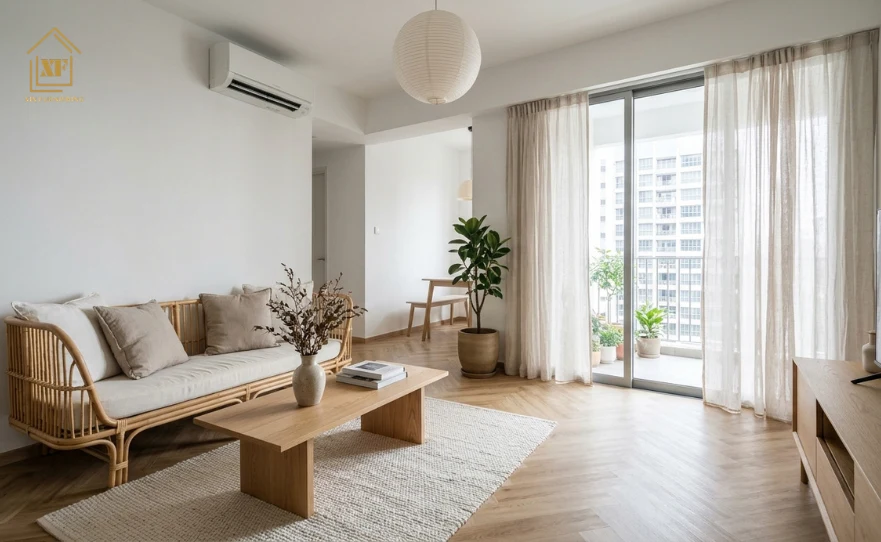
Bright, airy and the most popular choice in Singapore homes right now. It suits Scandinavian, Japandi, and minimalist schemes, and it keeps the pattern visible without feeling heavy.
Best in living rooms, dining areas and compact apartments that need brightness.
Warm natural oak herringbone
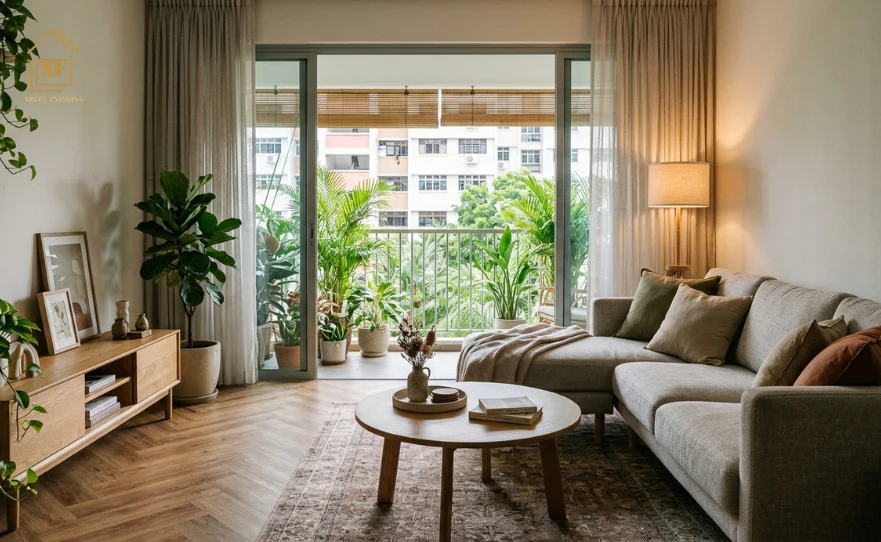
The most forgiving tone for this pattern. Enough warmth to feel inviting, enough grain to read as timber, quiet enough that the pattern leads.
Best in family living areas and whole-flat installations where the pattern runs through.
Grey herringbone
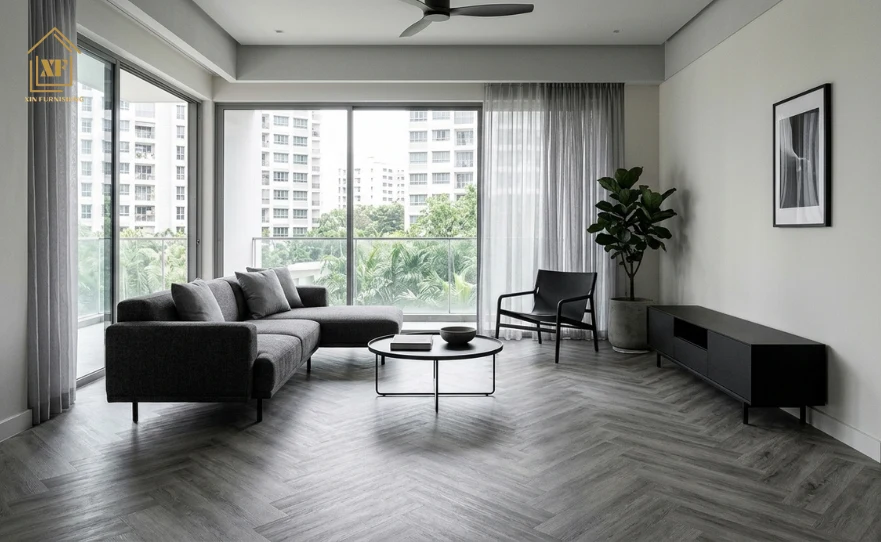
Cooler and more contemporary, suited to modern condos and office interiors. Works where the rest of the palette leans grey or monochrome.
Best in modern apartments, workspaces and minimalist interiors.
Dark walnut herringbone
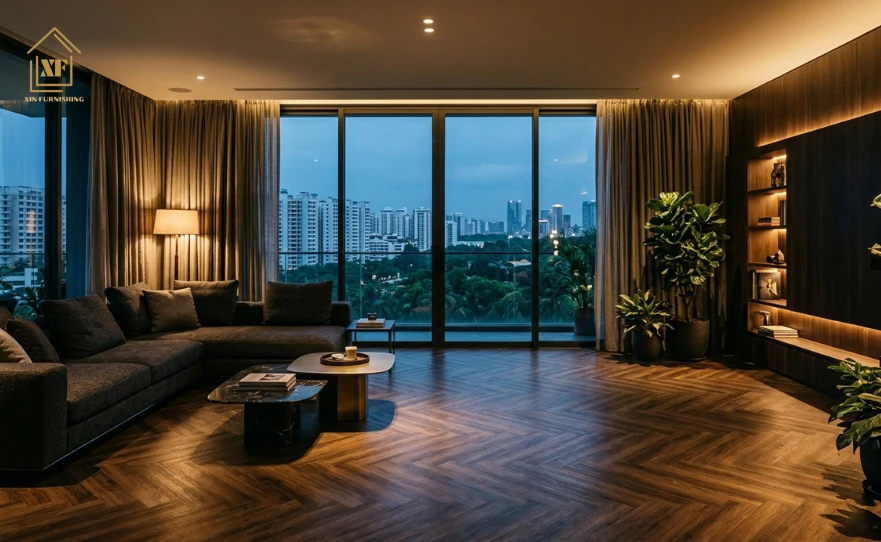
The boldest version. Dramatic and hotel-like, it needs space and light to carry it, since the pattern plus the depth of tone can be too much for a small room.
Best in larger living areas and feature zones.
Our wood vinyl flooring range includes herringbone formats across these tones.
Plank proportions: the specification that makes the pattern work
A detail almost nobody raises, and it decides whether the finished floor looks right.
Herringbone needs a length-to-width ratio of roughly 3:1 or 4:1. A 600 mm long by 150 mm wide plank gives a 4:1 ratio, the classic proportion.
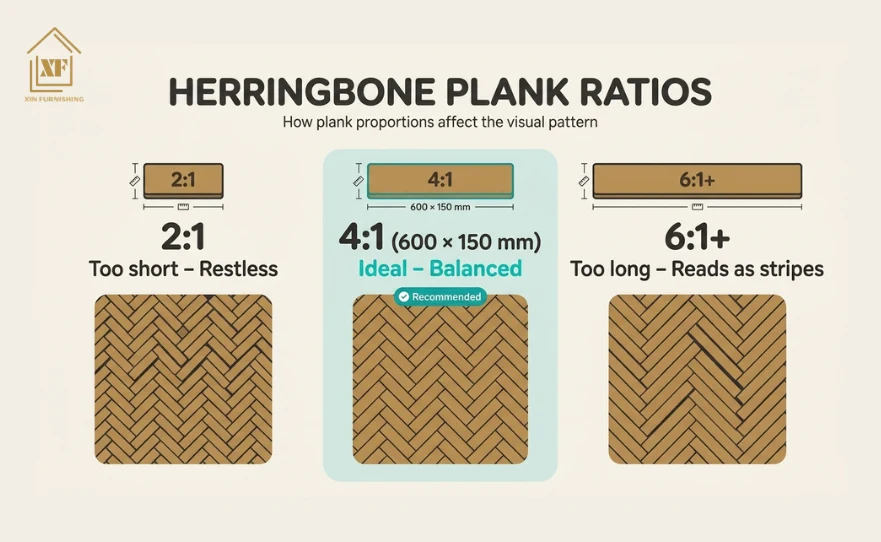
Too long, say 6:1 or beyond, and the pattern stretches out. The V becomes shallow and elongated, the rhythm slows, and from standing height it starts to read as diagonal stripes rather than as herringbone.
Too short, closer to 2:1, and the pattern becomes restless. The repeat happens so frequently that the floor looks busy, which fights almost every interior style popular here today.
Why it matters when buying: herringbone-specific products are manufactured in the correct proportion. Standard planks cut down to length for a herringbone layout often aren’t, and the result is a pattern that looks slightly off without the owner being able to say why.
Ask whether the product is a dedicated herringbone format or a standard plank being used for one. The answer tells you whether the proportion was designed or improvised.
What Herringbone Vinyl Flooring Costs
Roughly S$450 to S$10.50 per square foot, supplied and installed, compared with S$3.50 to S$8.00 for the same product laid straight.
That premium is 20 to 30 per cent, and it comes from three things rather than from the planks themselves.
- Wastage: Every room edge needs angled cuts, and those offcuts have nowhere else to go. Budget 8 to 12 per cent wastage against 5 to 7 per cent for a straight lay.
- Labour: Herringbone takes 30 to 50 per cent longer to install. A full HDB flat takes two to three days, compared with one to two for straight plank.
- Planning: Set out the layout before laying anything, and get the starting line right.
What does not change the price: the tone. Dark walnut costs the same as light oak. If someone quotes you more for a darker herringbone, they’re pricing the design, not the work.
Buying from a direct vinyl flooring supplier in Singapore helps here too, since material cost makes up a bigger share of a herringbone job than a straight lay, and that is the part a distribution chain marks up.
Our vinyl flooring cost guide covers the full picture, including levelling, skirting and disposal.
See The Pattern At Full Scale
Herringbone is the one layout you cannot judge from a sample. The pattern only reads at scale, and a few planks on a showroom shelf tell you nothing about how it will look across your living room.
Our Woodlands showroom has herringbone laid out properly, so you can see how the pattern sits, how the tone reads under real light, and how it would look in the width of your own room.
WhatsApp +65 9690 2060 for a free site measurement.
Frequently asked questions
What is the difference between herringbone and chevron?
Herringbone planks have square ends and meet at 90 degrees, so one plank butts into the side of another. Chevron planks are cut at an angle and meet in a continuous point. Chevron is more dramatic, wastes more material, and requires more precise installation.
How much more does herringbone cost than straight plank?
About 20 to 30 per cent, due to higher wastage, longer installation, and extra planning. The planks themselves cost roughly the same.
How much extra material should I order?
Budget 8 to 12 per cent wastage for herringbone, against 5 to 7 per cent for a straight lay. Chevron needs more again, closer to 15 per cent. A straight border around the perimeter reduces herringbone wastage.
Does herringbone make a room look bigger?
In a room with enough width, the diagonal movement adds depth. In a narrow corridor or a small bedroom, the pattern gets cut off at both walls before it reads, and a straight lay in a pale tone would do more for the sense of space.
Can you lay herringbone vinyl over existing tiles?
Yes, using the same overlay method as straight plank vinyl, provided the tiles are sound and reasonably level. Levelling matters more here because an uneven base makes it harder to hold a precise pattern.
How long does installation take?
Roughly 30 to 50 per cent longer than a straight lay. A full HDB flat usually takes two to three days, compared with one to two for a straight lay.
Is herringbone harder to clean?
No. The surface is the same as any other vinyl plank, and the joints are no more numerous than in a straight lay. Cleaning is the same.
Should I use herringbone through the whole flat?
Usually not. It works best as a feature in one area, with a straight lay in the same tone elsewhere. That keeps the impact and avoids paying the premium across every room.
What thickness should I choose?
The same as any other vinyl: 5mm for most homes, 6.5mm where you want a built-in underlay for comfort and sound. The wear layer matters more than the thickness, and 0.5 mm is the figure to ask for. Our guide covers how to judge vinyl flooring quality.