Ten years ago, you could spot a fake marble floor from across the room. The pattern repeated, the surface was flat, and nobody was fooled.
Walk through a newly renovated flat in Singapore today, and you often cannot tell. Marble-look vinyl has become one of the most requested finishes in the market, and it happened fast.
Marble Vinyl Flooring Is Trending IN SINGAPORE: 5 Reasons
Three things converged. The printing got good enough to pass at standing height, the price gap against real marble became impossible to ignore, and the shift to overlay renovations made a marble floor something you could have in a day rather than a fortnight.
A fourth reason sits underneath it all: real marble was never very practical in a Singapore home.
Reason 1: The Designs Stopped Looking Fake
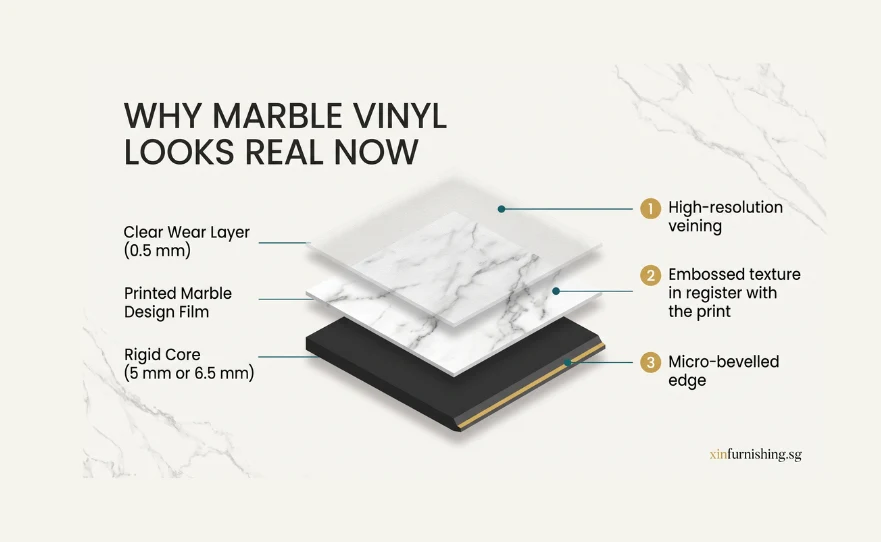
Older marble-effect vinyl had a flat printed surface and an obvious pattern repeat. You could spot it from across a room, and nobody aspiring to a marble floor wanted one.
Three things changed:
Printing resolution
Modern design films reproduce veining with enough detail to survive close inspection, including the soft gradients where a vein feathers out.
Embossed texture
The surface is now textured in register with the printed pattern, so what you feel matches what you see rather than being uniformly smooth.
Tile format and bevels
Larger tiles with micro-bevelled edges read as individual stone slabs, because the bevel does the job a grout line does on a real floor.
The result is a floor that most people cannot identify as vinyl from standing height in a furnished room. Up close, you still can, because a print cannot reproduce marble’s translucency. But very few people inspect a floor from twenty centimetres away.
Reason 2: Real Marble Costs Five Times As Much
Real marble in a 4-room flat runs well into five figures, and that is before hacking, debris disposal and the sealing it needs every few years. Marble-look vinyl costs roughly a fifth and comes with none of those extras.
For most homeowners, the decision was never between marble and vinyl. It was between a marble look and no marble look at all. Our vinyl flooring cost guide covers the full picture.
Reason 3: Real Marble Struggles In This Climate
Even for people who could afford it, marble struggles in a Singapore home.
It stains: Marble is porous, so wine, oil, coffee, and citrus mark the stone instead of sitting on it. Sealing helps, and sealing has to be repeated.
It chips and scratches: Despite its reputation for permanence, a dropped pan leaves a mark, and only a specialist can polish it out.
It is cold and hard underfoot: Some people want that. In a home with young children or elderly family members, it is unforgiving.
It is slippery when wet: Polished marble at an entrance during monsoon season is a genuine hazard.
Vinyl answers all four. The surface is non-porous, the wear layer absorbs daily knocks, it feels warmer and softer underfoot, and a matt finish grips far better when wet than polished stone.
Reason 4: You Can Now Have It In A Day
This is the Singapore-specific reason most guides miss.
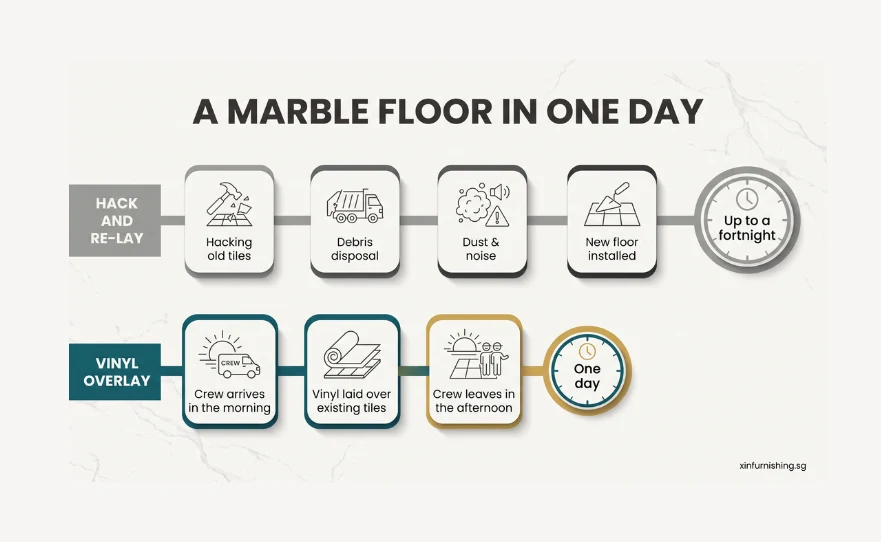
You can lay vinyl directly over existing tiles. No hacking, no debris, no permit complications, and most homes are finished in a single day.
That changed the calculation entirely. A marble floor used to mean a disruptive renovation: tearing out the old floor, days of dust and noise, and neighbours who stopped saying hello. Now it means a crew arriving in the morning and leaving in the afternoon.
Plenty of people who would never have taken on a marble renovation will happily take on a one-day overlay. Our guide covers laying vinyl over existing tiles and when the tiles are suitable.
Reason 5: Light, Hotel-Style Interiors Took Over
Interiors have moved towards light, open, hotel-like spaces, and marble sits at the centre of that aesthetic. Pale floors with soft veining make a compact flat feel larger and brighter, which matters in HDB units with limited natural light.
Renovation content on Lemon8, Instagram and TikTok accelerated it. People see a finished flat, save the image, and arrive at a showroom asking for that floor. Marble photographs extremely well, giving it a reach textured or timber finishes don’t.
At the darker end, near-black marble with white veining has become a signature choice for condo living areas, anchoring a large open-plan space that a light floor would leave looking washed out.
Who Is Buying Marble Vinyl, And For Which Rooms

HDB homeowners choosing it for kitchens, entryways and living rooms, usually in lighter designs that open up the space.
Condo owners choosing darker marble for large open-plan living and dining areas.
Landlords, because it looks premium in listing photos and costs little enough to replace between tenancies.
Shops, cafés and showrooms, where the floor does real work in how a space reads to customers.
Where Marble Vinyl Is The Wrong Choice
Worth saying plainly, because the trend has pushed it into places it does not belong.
Full bathrooms, where a gradient to the floor trap and daily water work into the joints over time, which is why tiles remain correct here.
If you genuinely want the material, since vinyl reproduces the look and not the stone, buy marble and accept the maintenance.
Avoid balconies and outdoor areas, where indoor vinyl isn’t built for direct sun and rain.
Avoid placing very heavy fixed furniture on small feet, which can dent any vinyl floor unless you use load spreaders.
Four Things To Check Before You Buy

The trend has brought plenty of poor products, so check these before you commit.
The wear layer, in millimetres: Treat 0.5 mm as your minimum. On a light marble floor, this matters more than usual, because a worn traffic path shows on white far sooner than on a patterned design.
The finish: Matt hides marks much better than gloss. Polished-look marble vinyl photographs beautifully and shows every footprint.
The pattern repeat: Cheap prints repeat every few tiles, and once you notice it, you cannot unsee it. Ask how many unique faces the design has.
The tile size and bevel: Larger tiles with micro-bevelled edges read far more convincingly than small, flat-edged ones.
Our stone vinyl flooring range includes Sierra Marble E3004, a bright white with fine grey veining, and Ebony Vein E3005 at the dark end. Both come as bevelled tiles in a matt finish, in 5 mm or 6.5 mm, with a 0.5 mm wear layer.
Marble is only half the picture. Our guide to why stone vinyl flooring is trending covers the terrazzo and concrete-effect designs in the same range.
Frequently Asked Questions
Does marble vinyl flooring look real?
From standing height in a furnished room, it looks convincingly real, especially in larger bevelled tiles with a matt finish. Up close, you can tell, because a printed surface cannot reproduce marble’s translucency.
How much cheaper is marble vinyl than real marble?
Roughly a fifth of the cost. Marble-look vinyl runs S$3.00 to S$8.00 per square foot installed, compared with S$15.00 and above for natural marble, and it avoids the hacking, disposal and sealing costs entirely.
Is marble vinyl flooring slippery?
Less so than polished marble, which is one of its practical advantages in a wet climate. Matt finishes grip better than gloss.
Can I use marble vinyl in a kitchen?
Yes, and it is one of the better rooms for it. The surface is waterproof and wipes clean, and it handles cooking grease without staining like real marble.
Will it go out of fashion?
Marble has been in fashion for several thousand years, which is a reasonable indicator. If you’re concerned, choose softer, less dramatic veining, since bold Calacatta-style patterns date faster than subtle ones.
Does marble vinyl fade in sunlight?
Any floor fades over years under strong direct sun. Blinds or UV film help, and it is worth planning for in west-facing units with large windows.
How do I clean it?
Sweep or vacuum, then damp mop weekly with a pH-neutral cleaner. Light designs benefit from a mid-week mop. Our guide covers cleaning vinyl floors.