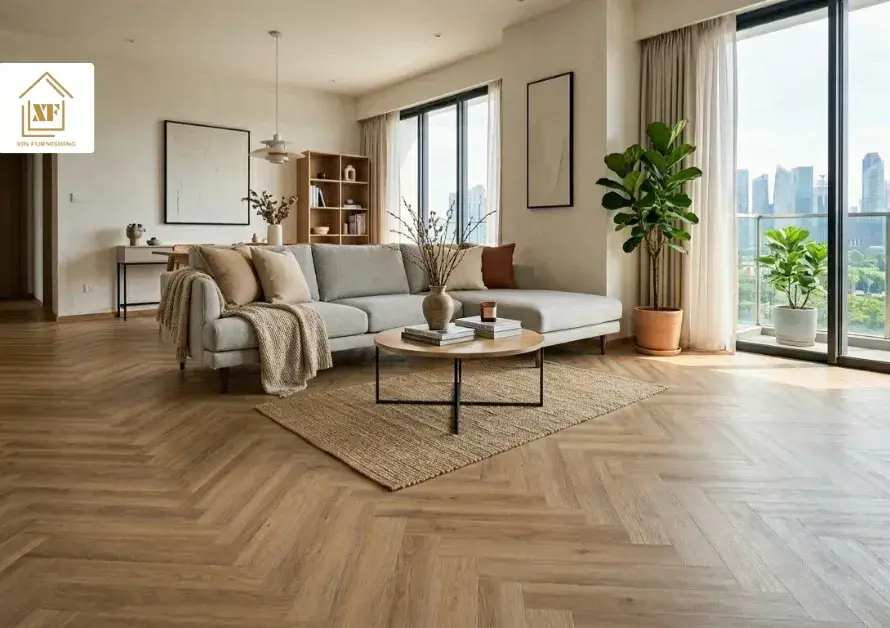
You walk into a resale flat, and the floor is the original beige homogeneous tile, chipped near the kitchen. Hacking it out means noise, dust, an HDB permit and a week or more of work. Laying vinyl tiles over it takes about a day.
That’s why vinyl tiles have become such a common choice. Look into vinyl flooring Singapore options, and you’ll find tiles and planks that look like stone, marble, or concrete, feel softer than ceramic, and usually go straight over the floor you already have. They aren’t right for every room, though, and quality varies a lot between products that look the same in a showroom.
This guide covers what vinyl tiles are, the styles you can get, what they cost per square foot, the HDB rules for laying them over old tiles, and the rooms where they do well or badly.
What Are Vinyl Tiles?
Vinyl tiles are floor tiles made mostly from PVC (polyvinyl chloride, a tough, water-resistant plastic) instead of clay. Each tile has a printed design layer that copies stone, marble, concrete or wood, with a clear wear layer on top. The wear layer is the see-through coating that takes the scratches and scuffs so the picture underneath stays clean.
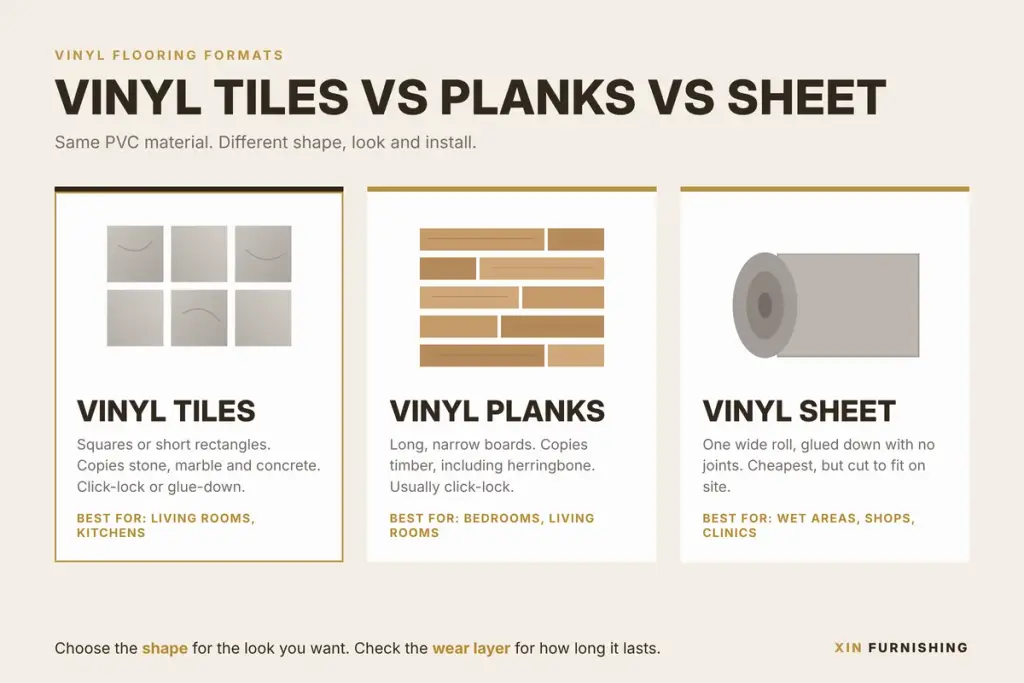
Here, “tile” describes the shape, not the material. If you’re new to vinyl, start with our guide on what vinyl flooring is and how it’s made. It comes in three formats:
| Format | Shape | What it usually copies | How it’s laid |
|---|---|---|---|
| Vinyl tiles | Squares or short rectangles | Stone, marble, concrete, patterned tile | Click-lock or glue-down |
| Vinyl planks | Long, narrow boards | Timber | Click-lock or glue-down |
| Vinyl sheet | One wide roll | Almost anything | Glued down in one piece |
Same material, different shape. A marble-look floor looks more real in a tile format, because real marble is cut into slabs and tiles, not long boards.
Types of Vinyl Floor Tiles You’ll Find in Singapore
Most vinyl floor tiles sold here fall into one of four types. The type matters more than the design because it determines how the floor feels, how it’s installed, and how long it lasts.
- Luxury vinyl tile (LVT): a thick, layered tile with a flexible PVC core and a strong wear layer. It’s softer and quieter underfoot. Most home vinyl in Singapore is LVT or a close cousin. Here’s our full guide to what LVT flooring is made of, layer by layer.
- SPC tiles: SPC stands for stone plastic composite. The core mixes limestone powder with PVC, so the tile is stiffer and harder. Some people like the firm feel, and others find it cold.
- Peel-and-stick tiles: thin tiles with glue already on the back. They’re cheap and fine for a quick rental refresh, but the glue can let go at the edges in a humid flat, so treat them as a short-term fix.
- Vinyl composition tile (VCT): hard, thin tiles used in schools, clinics and shops. You’ll seldom see them in homes.
Home tiles are fixed in one of two ways. Click-lock tiles snap together edge to edge and “float” over the old floor with no glue. Glue-down tiles are stuck to the floor below. Click-lock is the usual choice for homes because you can swap out a damaged tile later.
Popular Vinyl Tile Styles: Stone, Marble, Concrete and Wood
Most people looking at vinyl tiles want the look of something expensive without the price or the upkeep. These are the styles Singapore homeowners ask for most:
- Stone and slate: soft greys and earthy beiges with natural texture. Grey vinyl tiles are popular in HDB flats because they hide dust and suit both white and wood carpentry. Browse our stone-look vinyl tiles in 5mm and 6.5mm to see the range.
- Marble: white or cream with grey veins, for a hotel-lobby look in the living room. Real marble needs sealing and stains easily, and vinyl doesn’t.
- Concrete and microcement: smooth, plain grey for an industrial or Japandi home. Explore our microcement-look vinyl flooring if you like a floor with no visible pattern.
- Wood: wood vinyl tiles exist, though most wood looks come as planks. If you want timber, see our wood vinyl flooring range, including herringbone.
Tile-look vinyl flooring has one more trick. Many designs have printed “grout” lines, so the floor reads as tiles from across the room but has no real grout to scrub.
Where Vinyl Tiles Work Best in a Singapore Home
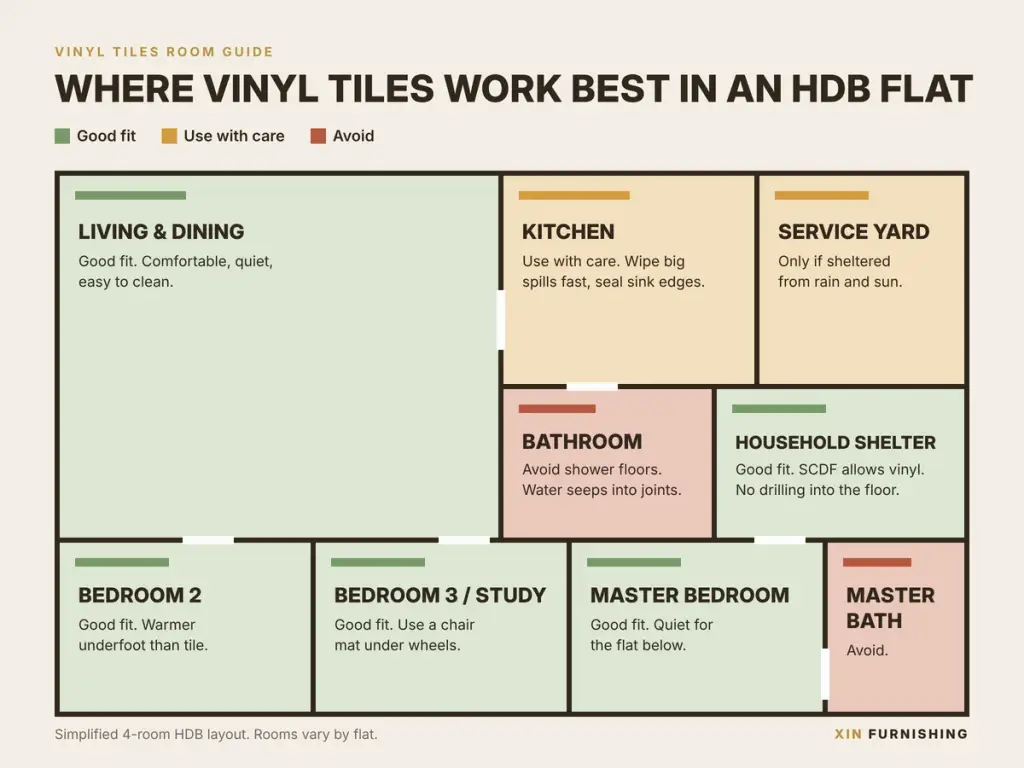
Vinyl tiles have a waterproof surface, but water can still creep through the joints between tiles. That one fact decides most of this table.
| Room | Good fit? | Why |
|---|---|---|
| Living room | Yes | Comfortable, quiet, easy to clean |
| Bedrooms | Yes | Warmer underfoot than ceramic after a night of air-con |
| Kitchen | Yes, with care | Handles spills and cooking. Wipe up big spills fast and seal the edges near the sink |
| Study and home office | Yes | Quieter than tile under chair wheels. Use a chair mat |
| Entryway and service yard | Yes, if sheltered | Avoid spots that get rain or direct afternoon sun |
| Full bathroom (shower area) | No | Daily standing water gets under the joints |
| Household shelter (bomb shelter) | Yes | SCDF lists vinyl flooring as permitted work. Click-lock tiles need no drilling into the shelter floor |
Vinyl wall tiles for the bathroom are a different product. Thin vinyl wall panels can cover tired bathroom walls, because walls don’t sit in water the way a shower floor does.
Can You Overlay Vinyl on Tiles in an HDB Flat?
Yes, and it’s the main reason vinyl tiles are so popular here. Under HDB’s Building Works guidelines, laying vinyl finishes needs no permit. Replacing ceramic, homogeneous or marble finishes does need one.
When you overlay vinyl on tiles in a flat that already has floor finishes, HDB says the work should not:
- raise the floor into a platform
- use cement screed
- hack or remove the existing floor finishes
In practice, three things decide whether an overlay works well:
- The old floor must be level and solid: Fix hollow or cracked tiles first, or the new tiles will flex and click. A flat floor matters more for vinyl tiles than for planks, because a dip shows up along straight tile lines.
- Floor height goes up: A 5mm tile raises the floor by about 5mm, a 6.5mm tile by 6.5mm. Doors may need trimming at the bottom. Ask your installer to check door clearance during the site visit.
- Edges need finishing: Skirting or edge trims hide the expansion gap left around the room so the floor can move slightly in Singapore’s heat.
There’s more detail in our guide to installing vinyl flooring over existing tiles.
How Much Do Vinyl Tiles Cost in Singapore?
Vinyl tiles in Singapore usually cost S$3.50 to S$8 per square foot, including supply and installation. Where you land in that range depends on the thickness, the wear layer and how much prep the floor needs.
| Level | Price per sq ft (installed) | What you usually get |
|---|---|---|
| Entry | S$3.50 to S$4 | Thinner tiles, thinner wear layer |
| Mid-range | S$4 to S$7 | About 5mm tiles with a 0.5mm wear layer, click-lock |
| Premium | S$7 to S$8+ | Thicker tiles with built-in underlay |
Extras are billed on top. Skirting usually runs S$3 to S$6 per running foot. A bare BTO floor may need screeding and self-levelling first. For a whole-flat estimate, see our 2026 guide to the cost of vinyl flooring in Singapore.
A low supply-only price can look attractive online. Check what it leaves out: installation, skirting, levelling and removing old flooring often double the final bill.
Vinyl Tiles vs Ceramic Tiles vs Laminate
This is the comparison most homeowners make before they decide. There’s no single winner. Each one suits a different kind of home.
| Vinyl tiles | Ceramic or homogeneous tiles | Laminate | |
|---|---|---|---|
| Feel underfoot | Soft, warm, quiet | Hard, cool, echoes | Firm, a bit hollow |
| Water | Waterproof surface, joints need care | Fully waterproof | Core swells if wet |
| Installation | Often 1 day, over old tiles | Days of work, hacking needs a permit | 1 to 2 days, dry areas only |
| Lifespan | About 10 to 15 years with a 0.5mm wear layer | 20+ years | Shorter if it ever gets wet |
| Repairs | Swap one click tile | Chipped tile is hard to match | Swap boards, but water damage spreads |
| Best for | Living rooms, bedrooms, kitchens | Bathrooms, wet areas | Bedrooms only |
Vinyl tile vs laminate is the closer contest, since both are click floors. The big difference is the core. Laminate has a wood-fibre core that swells when it stays wet, and vinyl doesn’t. In Singapore, where average humidity is above 80% (NEA data), vinyl is the safer choice.
How to Choose Good Vinyl Tiles
Two tiles can look identical and still perform very differently. Before you order, check these six things:
- Wear layer: 0.3mm suits light use. Aim for 0.5mm in a busy home with kids or pets.
- Total thickness: 5mm is the common choice for overlays. 6.5mm with built-in underlay feels softer and cuts footstep noise for the flat below.
- Locking system: Ask for a 4-sided click-lock. Weak locks often cause gaps after a few months.
- Low VOC: VOCs (volatile organic compounds) are gases some cheap vinyl gives off, which cause that “new plastic” smell. Ask whether the product is certified under the Singapore Green Labelling Scheme or a similar low-VOC standard.
- Warranty: Get the residential product warranty and the workmanship warranty in writing, and check what each covers.
- Real samples: Take samples home and look at them in your own light, by the window and at night. Grey and beige shift a lot under warm bulbs.
Choosing Vinyl Tiles for Your Home
Vinyl tiles give you the look of stone, marble or concrete at a fraction of the cost, and they usually go straight over your old floor without hacking. Pick the room first, then the style, then check the wear layer and the lock. That order saves most of the regret.
Xin Furnishing sells direct, so there’s no middleman in the price. Our vinyl flooring Singapore range covers stone, marble, microcement and wood designs in 5mm and 6.5mm. Our team can also check your floor level and door clearance on site, so you know what an overlay involves before you commit.
Book a free site measurement and quote and see the samples in your own home.
Frequently Asked Questions
Are vinyl tiles waterproof?
The surface is. Water won’t soak into a good vinyl tile the way it soaks into laminate or timber. The weak spot is the joint between tiles: standing water can seep through over time. That’s why vinyl tiles suit kitchens but not shower floors.
Can I lay vinyl tiles myself?
Click-lock vinyl tiles are DIY-friendly in a small, square room with a flat floor. Most HDB flats need trimming around door frames, kitchen cabinets and pipes, plus an even expansion gap and skirting. A professional crew often finishes a whole flat in a day, and a badly laid floor is the most common reason tiles gap or click.
Do vinyl tiles scratch easily?
Not from normal living, if the wear layer is 0.5mm. Sand and grit cause most scratches, so a doormat and regular sweeping matter more than you might think. Put felt pads under chair and table legs, and never drag heavy furniture across the floor.
Will vinyl tiles look cheap?
Older vinyl did, with flat printing and a plastic shine. Current tiles use high-resolution printing and textured surfaces that follow the stone or wood grain, so most visitors can’t tell from standing height. Matte finishes look the most natural. Very glossy marble looks are the easiest to spot as vinyl.
How long do vinyl tiles last in Singapore?
A quality tile with a 0.5mm wear layer lasts about 10 to 15 years in a normal home. Cheaper tiles with a 0.2mm or 0.3mm wear layer wear through faster in hallways and kitchens. Gentle cleaning helps too: a damp mop with mild detergent, and no steam mops, which push heat and moisture into the joints.