Waterproof vinyl flooring is sold on one promise: water does nothing to it. That promise is true, but it’s narrower than most people assume.
The plank is waterproof. The floor is not the same thing. Understanding that difference can stop a flooring mistake in a Singapore home.
Is vinyl flooring waterproof?
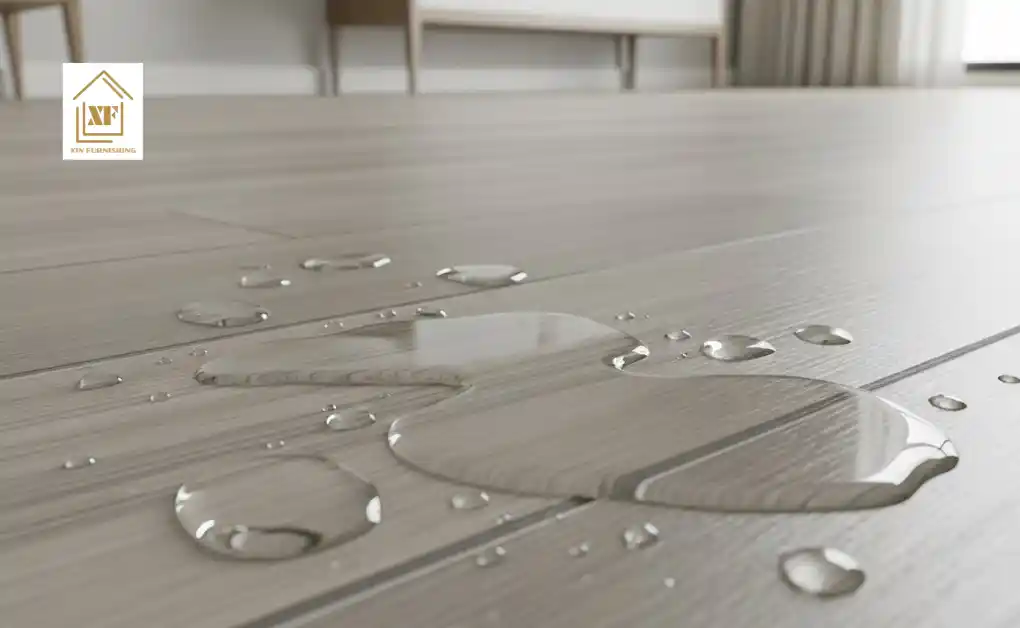
Yes. The plank itself is waterproof through its entire thickness, not just on the surface. Spills, mopping, humidity and a leaking air-con unit do nothing to it.
What is not waterproof is the floor as a system. Water sitting at the joints for hours can work its way through to the subfloor underneath. That is why vinyl is right for kitchens and wrong for bathrooms, and why “waterproof” needs the explanation below.
Waterproof Vs Water-Resistant: What The Words Mean
Marketers use these interchangeably, but they are not the same.
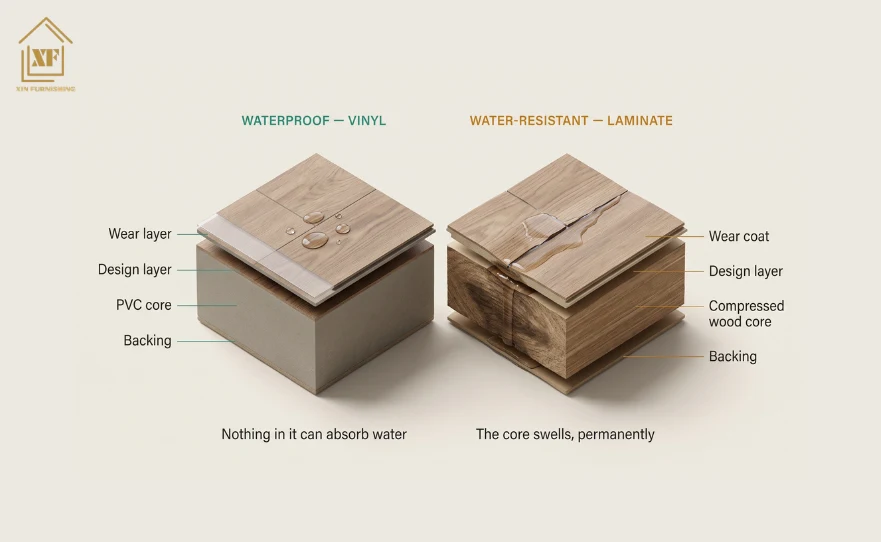
Water-resistant means the surface repels water for a period. Wipe a spill up and nothing happens. Leave it, and water eventually gets through. Laminate is water-resistant.
Waterproof means water does nothing to the material, no matter how long it sits there. Submerge a vinyl plank in a bucket for a week, then take it out; it is unchanged.
The distinction matters because of what sits underneath. Laminate has a compressed wood core, so once water passes the surface, the board swells permanently. Vinyl has no wood, so nothing swells.
If a supplier describes their vinyl as “water-resistant”, ask which they mean. Most vinyl sold in Singapore is genuinely waterproof, but suppliers often use the term loosely out of habit.
What Makes Vinyl Flooring Waterproof
This is the actual mechanism, and most articles get it wrong by crediting the backing layer.
Vinyl is PVC. It is a plastic, and plastics do not absorb water. That applies to the design layer, the core, and the backing. No part of the plank can absorb water and swell.
Compare the alternatives:
- Laminate has a high-density fibreboard core, which is compressed wood
- Engineered wood has a plywood core, which is also wood
- Solid timber is wood all the way through
All three absorb moisture. Vinyl does not, and that single fact is why it dominates Singapore renovations.
Our guide explains what vinyl flooring is and how the layers are built.
The Best Waterproof Flooring Options In Singapore
Vinyl is not the only waterproof option. Here is how the realistic choices compare.
- Tile is the only one that is waterproof as a complete system. It is laid on a waterproofing membrane with grouted joints, which is why bathrooms are tiled.
- Vinyl is waterproof as a material. That covers everything a kitchen, living room or bedroom will do to it, and it is cheaper, warmer and quieter than tile.
- Sheet vinyl is the specialist answer when you need a seamless floor, which is why clinics and commercial kitchens use it rather than homes.
For the full comparison across every material, see our guide to choosing flooring for your home.
What A Waterproof Surface Does Not Mean
Four things people reasonably assume and shouldn’t.
- It does not mean you can flood the room. The planks survive it. The subfloor and the skirting may not.
- It does not mean the joints are sealed. A floating floor has thousands. They are tight, not watertight.
- That doesn’t mean mould cannot grow. Mould grows on whatever sits on the floor, and underneath it if water gets trapped. The plank itself will not host it, but a damp subfloor will.
- That doesn’t mean the floor can go outdoors. Indoor vinyl isn’t built for direct sun and rain, no matter what the waterproof rating says.
The Joints: Where Water Actually Gets In
Everything above comes down to this.
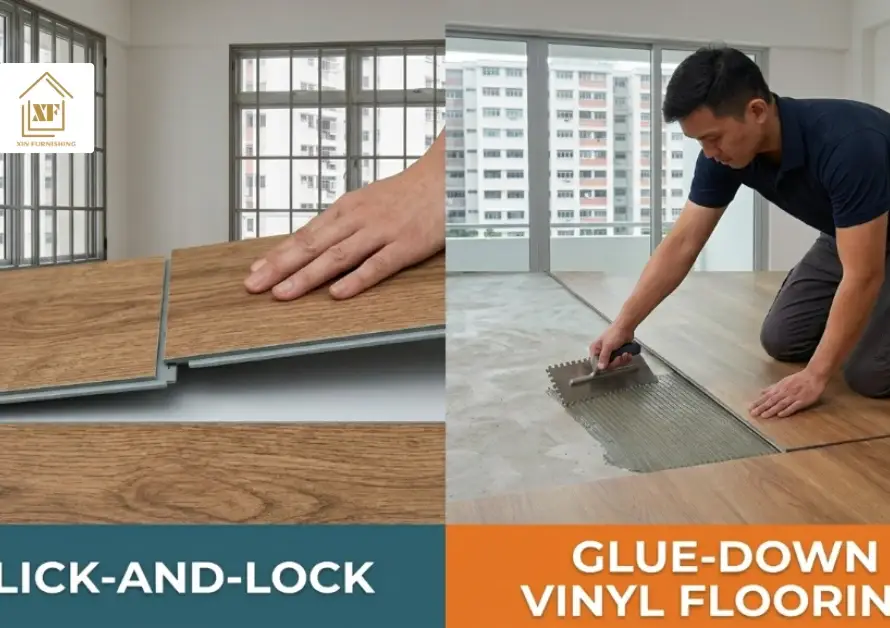
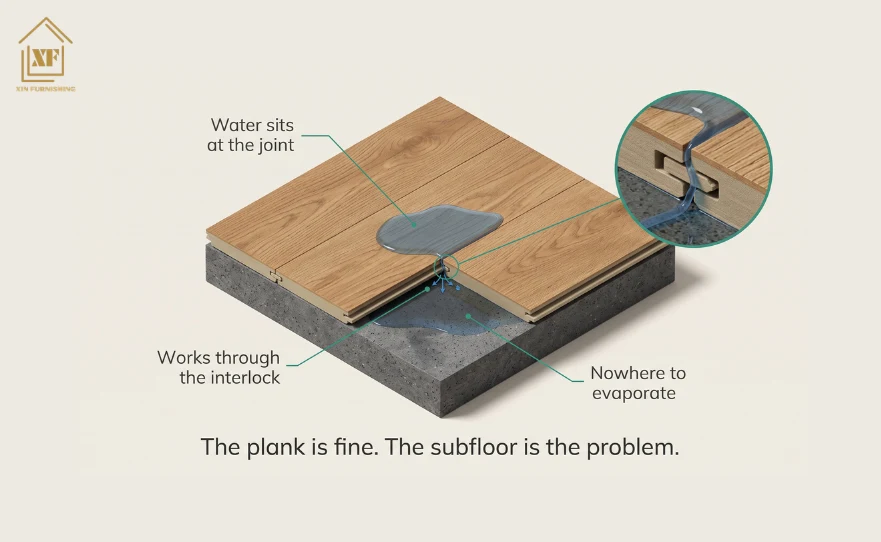
A click-lock vinyl floor is a floating floor made of interlocking planks. The joints are mechanically tight, and a good click system like Unilin 2G keeps them tight for years. But they are joints, not welds.
Water on the surface wipes off. Water standing at a joint for hours slowly finds its way through to the subfloor. There it has nowhere to evaporate, which is how you end up with a smell, a damp patch, or mould beneath a floor that looks perfectly fine from above.
This is also why we specify glue-down and sheet vinyl for genuinely wet areas. Fewer joints, or none at all.
So, Why Can’t We Use Vinyl Flooring in Bathrooms?
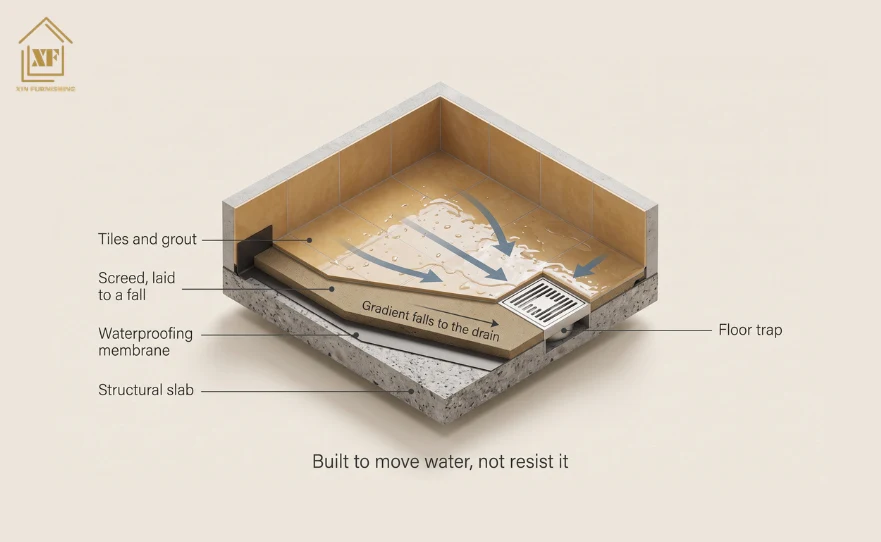
The question follows logically, and the answer lies in the floor’s construction, not the plank’s.
A Singapore bathroom is not a room that occasionally gets wet. It is laid with a gradient falling to a floor trap; it is designed for water to run across it, and it gets soaked daily. Add a waterproofing membrane under the tiles and a drain, and the whole assembly is built around managing water.
Install a floating floor in that room so water runs to the lowest point, the drain, passing over the joints the whole way. Over months, water reaches the subfloor and stays there.
You will find suppliers who say vinyl is fine in bathrooms. Some of them add that you should seal the edges, which concedes the point. Tiles remain the right answer here.
Where Waterproof Vinyl Flooring Genuinely Wins
Not bathrooms. Everywhere else.
Kitchens: Spills, steam, a dropped pot of water. The surface handles it all, and no grout can discolour.
Service yards and laundry areas: With one caveat: wipe up standing water rather than leaving it, since this room is most likely to flood.
Living and dining rooms: The daily reality is mopping, not flooding, and vinyl can be mopped weekly indefinitely.
Bedrooms and studies: Humidity alone destroys laminate and timber over years. Vinyl is unaffected.
After a leak: A burst pipe or overflowing washing machine can permanently damage a laminate floor, but not a vinyl floor, as long as you clear the water before it sits at the joints.
In Singapore’s climate generally: Relative humidity of 70% to 90% year-round is a slow test that wood-based floors eventually fail.
What To Specify For Wet Areas
If you are installing vinyl in a kitchen or service yard, four things matter.
Wear layer: 0.5 mm minimum. Wet areas get mopped more, and mopping wears it down.
Finish: Matt, not gloss. It grips better when wet, which matters where water is on the floor.
Click system: A named mechanical lock keeps joints tighter for longer than a generic one.
Skirting and the perimeter: Skirting covers the expansion gap at the walls, rather than sealing it. In a service yard, ask your installer how they are handling the perimeter.
Our guide covers how to judge vinyl flooring quality before you buy.
Not Sure If Vinyl Suits Your Wet Areas?
The honest answer depends on the room, and we will tell you where vinyl is the wrong choice.
Xin Furnishing is a waterproof vinyl flooring supplier in Singapore with in-house installation crews, a 0.5 mm wear layer and a 15-year residential warranty.
WhatsApp +65 9690 2060 for a free site measurement, or visit us at 101 Woodlands Avenue 12, #01-02, Singapore 737719.
Frequently Asked Questions
How long can water sit on vinyl before it causes a problem?
A spill wiped up within an hour won’t cause a problem. Water pooling at a joint for several hours can start working its way through to the subfloor. There is no exact threshold, so the rule is to clear standing water rather than leave it.
Can water get trapped under a vinyl floor?
Yes, and it is the real risk. A floating floor sits over the existing surface with no seal, so water that reaches the subfloor has nowhere to evaporate. That causes a lingering smell or mould rather than damage to the planks themselves.
How do I know if water has got underneath?
Look for a musty smell that returns after cleaning, a soft or hollow spot underfoot, or planks that feel slightly raised at a joint. If you notice any of those, lift a plank to check rather than mopping harder.
What happens if my washing machine floods?
Clear the water quickly, and the planks will be unaffected. The risk is water sitting at the joints and reaching the subfloor, where it cannot dry.
Do I need a moisture barrier under vinyl flooring?
Over a sound, dry existing floor, usually not. Over a bare concrete slab, especially a new one, it’s worth discussing a vapour barrier with your installer.
Is SPC more waterproof than LVT?
No. Both are PVC-based, and neither absorbs water. SPC is more dimensionally stable in heat, which is a different property. Waterproofing is not a reason to choose one over the other.
Does a thicker plank make the floor more waterproof?
No. Thickness affects comfort, sound and how well the floor handles an uneven subfloor. The material is waterproof at any thickness, and the joints are the weak point regardless.
Does waterproof mean mould-proof?
No. The plank will not host mould, but mould can grow on anything sitting on the floor, or underneath it if water gets trapped there and cannot dry.