Japandi has become the default for new HDB and BTO renovations in Singapore. Japandi flooring ideas follow the same look: pale wood, warm neutrals, low furniture, nothing shouting.
Almost everything rests on the floor. It is the largest surface in the room; it sets the undertone everything else has to match, and it is the hardest thing to change later. Get it right, and the rest follows. Get the undertone wrong, and no amount of linen and rattan rescues it.
What Japandi Flooring Actually Means
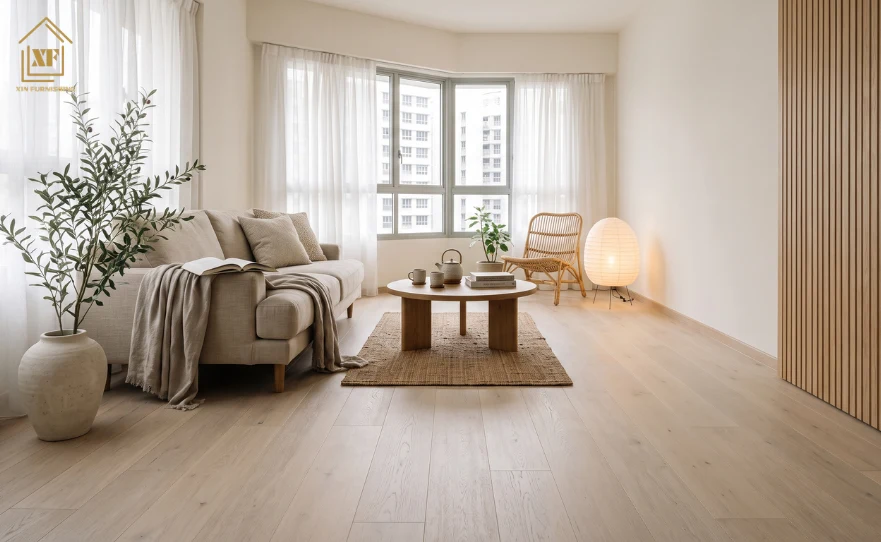
Japandi is Japanese restraint meeting Scandinavian warmth. Wabi-sabi finds beauty in simplicity; hygge finds it in comfort. The floor has to do both: quiet enough to disappear, warm enough to feel lived-in.
In practice, that means a pale-to-mid wood tone with a warm or neutral undertone, straight grain with visible texture, and a matt finish. No gloss, no heavy figuring, no red.
In Singapore, it also means vinyl rather than solid timber. Solid oak moves with humidity, and teak, the traditional answer in this climate, costs several times more. Good wood-look vinyl offers the same visual foundation while staying dimensionally stable in a flat that swings between air-conditioning and afternoon heat.
Eight Japandi Flooring Ideas And Tones That Work
1. Pale ash
The brightest option available. Minimal grain, almost no colour variation, maximum light return.
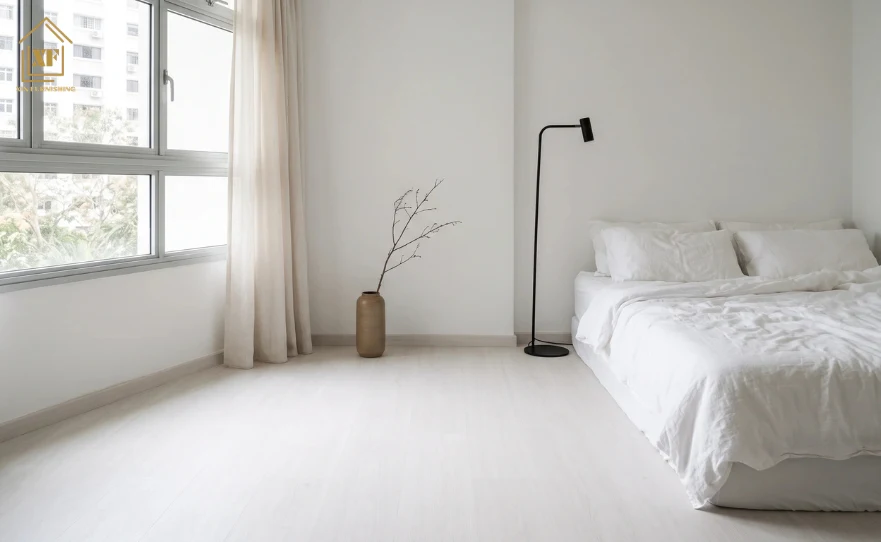
In a 3-room or small 4-room flat, this does more for the sense of space than paint ever will, reflecting daylight into corridors and corners that would otherwise stay dim. The trade-off is honest: a near-white floor shows hair and dust within a day or two.
Pairs with: warm white walls, pale oak carpentry, linen in oatmeal or stone, black metal fittings.
Avoid: cool grey walls, which flatten it, and heavy dark furniture, which makes it float.
Our picks: Pearl White E5001, Polar Ash E6005.
2. White oak
Slightly warmer than ash, with a soft visible grain that reads as timber without demanding attention.
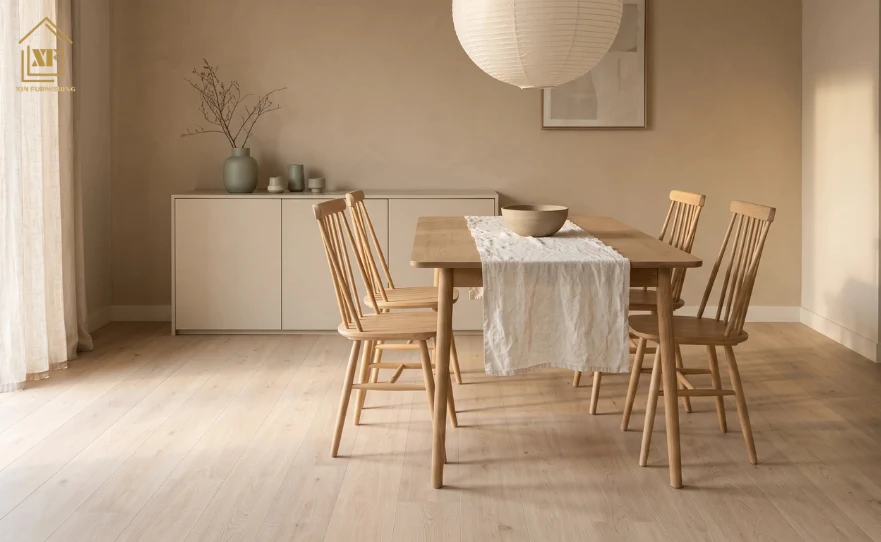
The classic Japandi foundation and the most widely specified tone in the style. It has enough grain to feel natural while staying quiet enough to sit under slatted panelling without competing. It also works with both halves of the palette, the cooler Japanese end and the warmer Scandinavian one.
Pairs with: off-white or oat walls, oak or beige laminate carpentry, muted sage and clay accents.
Avoid: nothing much. This is the forgiving one.
Our picks: Arctic Birch E5013, Frosty Maple E5014.
3. Light birch
Pale with a faint golden cast and a fine, even grain.
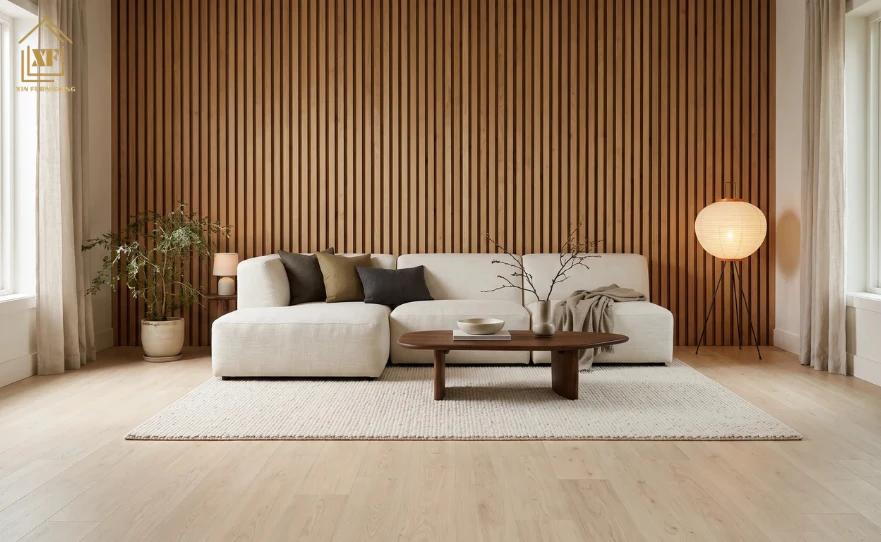
Birch sits in a useful middle ground: brighter than oak but warmer than ash, so it holds its warmth under 3000K lighting rather than going grey as very pale tones can. The fine grain stays quiet beneath a slatted feature wall, which is where two timber surfaces most often have to coexist.
Pairs with: warm white walls, oak slat panelling, paper lanterns, pale ceramics.
Avoid: heavily grained furniture, which overwhelms the floor’s fine texture.
Our pick: Honey Birch E5016.
4. Natural oak
Mid-tone, neutral undertone, the most forgiving floor in this list.
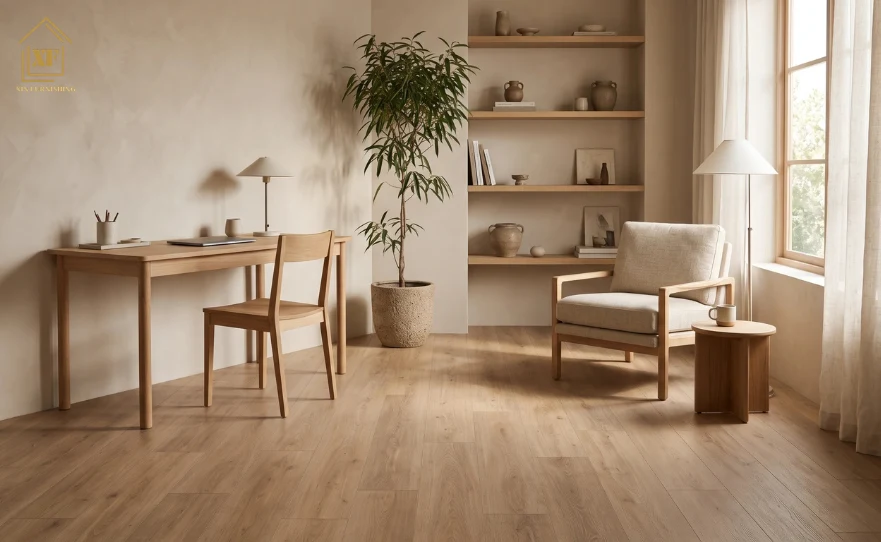
If you already own furniture, or the scheme is still forming, natural oak keeps your options open. It sits between light and dark, pairs with warm and cool furnishings alike, and does not date, which matters in a style whose appeal is longevity. It also works across Japandi, Scandinavian, Muji and wabi-sabi, so it suits anyone still deciding which of the four they are building.
Pairs with: almost anything in a neutral palette, warm or cool.
Avoid: nothing. This is the safe choice when the rest is undecided.
Our pick: Natural Oak E5002.
5. Honey oak
Warm golden-brown with gentle, even grain.
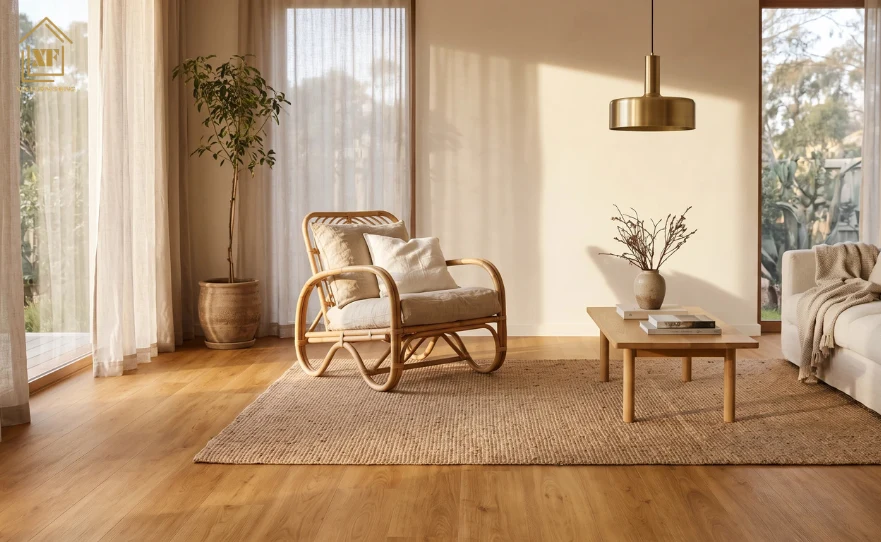
This leans more toward the Scandinavian half of Japandi than the Japanese half. It makes a newly handed-over flat feel established rather than clinical, and it pairs naturally with cream walls, linen upholstery, and rattan.
Pairs with: cream and warm white walls, rattan, undyed linen, brushed brass.
Avoid: cool grey walls and blue-white ceilings, which make the floor read yellow.
Our picks: Classic Honey E5004A, Golden Sand E5003A.
6. Warm greige
Soft grey-brown with a warm rather than blue undertone.
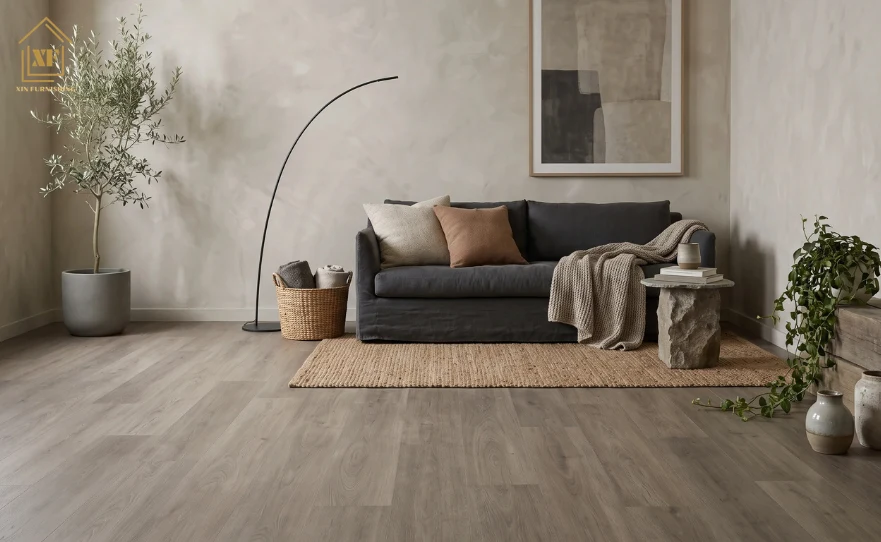
For Japandi schemes that tilt towards the quieter, more austere end of the style, where limewash walls or microcement surfaces are part of the plan. The undertone is everything here: greige works because the grey is warm. A cool blue-grey floor clashes with the warm neutrals the style relies on.
Pairs with: limewash or plaster walls, microcement surfaces, charcoal accents, stone and ceramic.
Avoid: golden or honey-toned carpentry, which pulls against the cooler floor.
Our picks: ask to see the greige-leaning designs in the wood series, or the lighter microcement range for a more mineral finish.
7. Mid walnut
Deeper brown with visible, characterful grain.
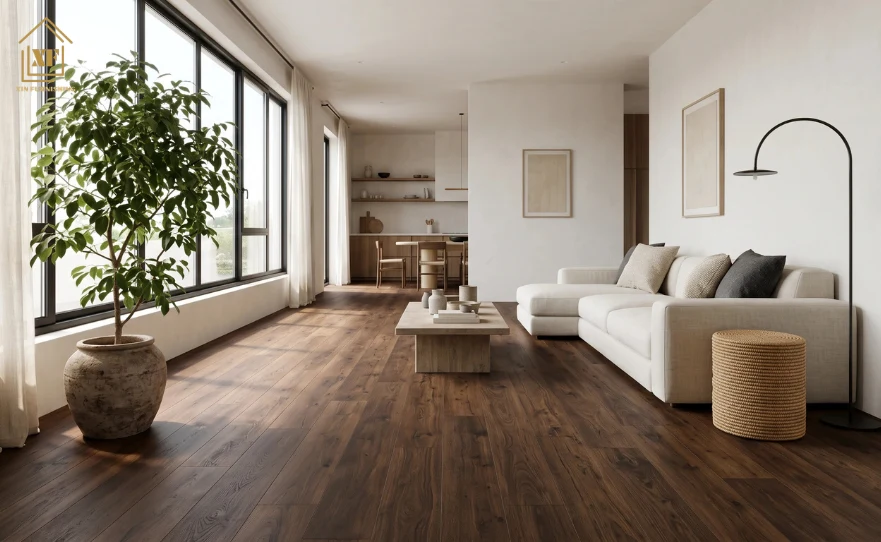
The alternative when you want depth rather than brightness. In a larger condo living area, a pale floor can leave the room feeling unanchored across that much surface, and walnut gives it a centre. It reads quietly expensive against pale walls and low furniture, but it needs light to work, and the rest of the scheme has to stay pale to hold the balance.
Pairs with: off-white walls, pale linen, black metal, one or two rattan pieces.
Avoid: dark walls, dark furniture, and compact rooms with limited daylight.
Our picks: Walnut Brown E5006, Heritage Oak E5005.
8. Smoked oak
Dark and muted, with grey-brown depth rather than red or orange.
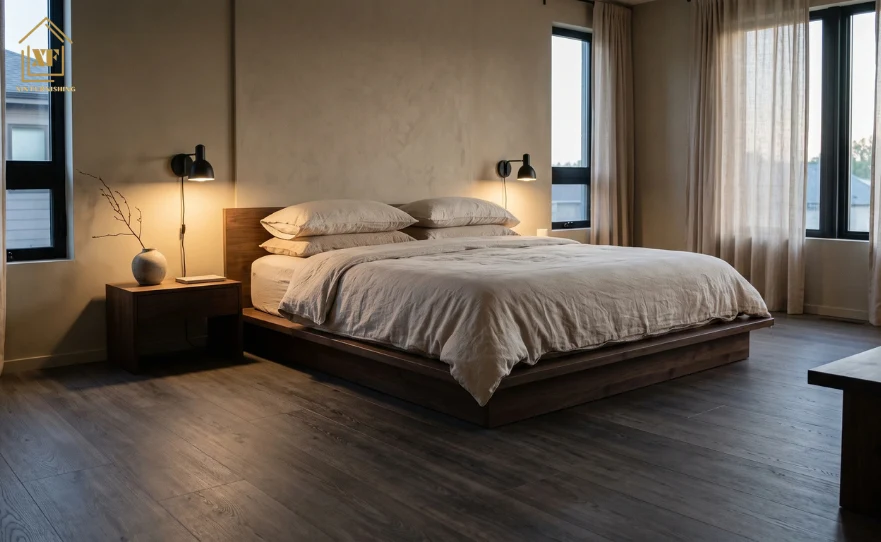
The most dramatic floor that still reads as Japandi rather than modern luxury. It suits a master bedroom aiming for hotel calm, where the room is contained, and the lighting is controlled. It shows dust and footprints more than anything else here, so treat it as a single-room decision rather than a whole-flat one.
Pairs with: pale bedding, oat or putty walls, warm bedside lighting, black fittings.
Avoid: whole-flat use, small rooms, and anywhere with poor natural light.
Our picks: Midnight Walnut E5024, Charcoal Oak E5011A.
The Red Undertone Rule
If you take one thing from this guide, take this.
Avoid any floor with a red or orange cast.
Cherry, mahogany, rosewood tones, and the warmer end of some oak finishes. Red undertones are the fastest way to break a Japandi scheme because every other material in the palette, the linen, the stone, the muted greens, the warm whites, is built on a neutral or warm-yellow base. A red floor fights all of them at once.
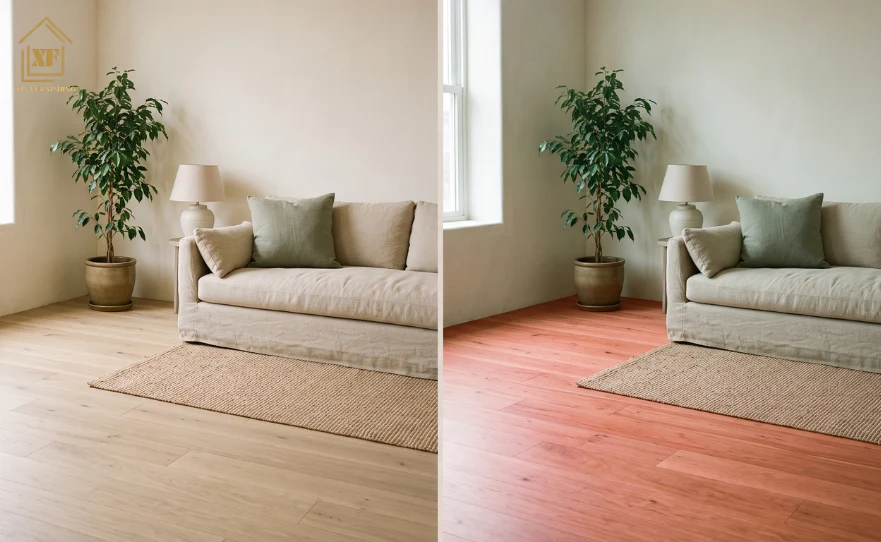
Hold a sample against a sheet of warm white paper in daylight. If it looks pink or orange against the paper, it will fight your walls.
The same applies in reverse to cool blue-whites. A blue-grey floor fights the warm neutrals that define the style. Warm or neutral, never cool, never red.
Japandi Plank Format And Layout
This is where the design guides stop, and flooring decisions start.
- Wide planks suit Japandi: Fewer joints mean a calmer surface, and calm is the whole point. A 220 mm plank reads quieter across a room than a 150 mm one.
- Lay them straight, along the longest wall: A simple straight lay is the Japandi answer. It extends the room and keeps the floor as background.
- Herringbone fights the style: It is beautiful and currently popular, but it is decorative, and Japandi is not. A herringbone floor announces itself, which is the opposite of what the room needs. If you want pattern, put it somewhere smaller than the floor.
- One floor throughout: Running the same plank from the living room through to the bedrooms extends the sense of space and holds the scheme together. This matters more in Japandi than in any other style, because the calm depends on continuity.
Matching The Floor To Slat Walls And Carpentry
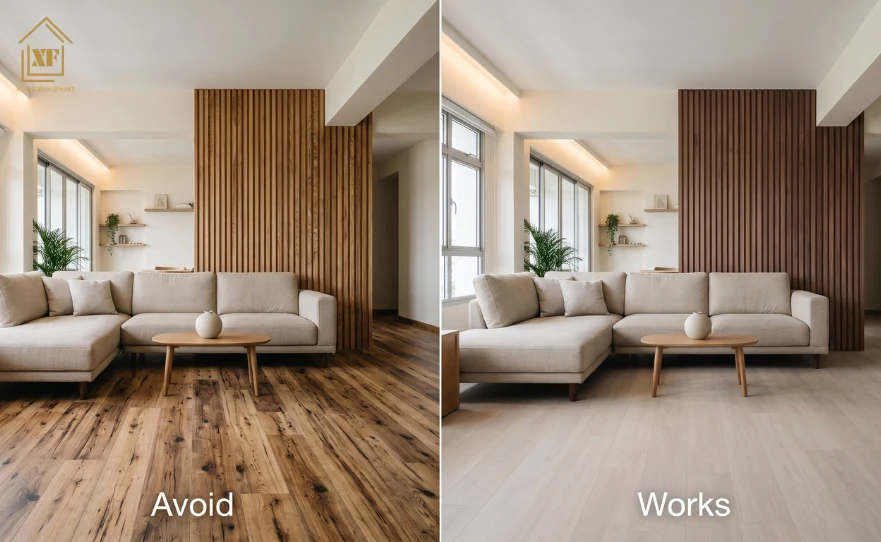
Japandi almost always includes timber somewhere else: a slatted feature wall, fluted panels, full-height carpentry.
The floor and the panelling should share an undertone, not a shade. Two to three shades apart is right. Identical reads flat; too far apart reads unrelated.
A pairing that works: pale oak floor with a deeper oak or walnut slat wall. The floor stays quiet, the wall carries the texture.
A pairing to avoid: heavily grained floor with a heavily grained slat wall. One surface should be the texture and the other should support it.
Our guide covers matching wall panels to your flooring in detail, including the slat and fluted formats that suit this style.
Frequently asked questions
What colour flooring is best for Japandi?
Pale to mid oak or ash with a warm or neutral undertone. Avoid anything with a red or orange cast, and steer clear of cool blue-greys. White oak is the most widely used and the safest.
Can you use dark flooring in a Japandi home?
Yes, in the right room. Mid-walnut or smoked oak grounds a larger space, but it needs pale walls and plenty of natural light. It works better in one room than across a whole flat.
Should Japandi flooring be matt or gloss?
Matt, always. Gloss reflects light in a way that reads polished rather than calm, and it shows every footprint.
Is herringbone suitable for a Japandi home?
Generally no. Herringbone is decorative, and Japandi is built on restraint. A straight lay in a wide plank suits the style far better.
What is the difference between Japandi and Muji flooring?
Muji sits paler and plainer, with minimal grain and almost no variation. Japandi allows more depth and more visible texture, and it tolerates a mid-tone floor where Muji would not.
Can I use vinyl for a Japandi home, or does it have to be real wood?
Vinyl is the practical choice in Singapore. Solid timber moves with humidity, and teak costs several times more. Wood-look vinyl with an embossed-in-register texture gives the same look without the instability.
How many wood tones can I use?
One dominant tone, plus at most one close relative. The floor is usually the dominant tone. Everything else goes neutral.
Will a pale floor make my HDB flat look bigger?
Yes, noticeably. Pale floors reflect light rather than absorbing it, which matters most in compact units and corridors with no natural light.
Should Japandi vinyl flooring have bevelled or square edges?
A shallow micro-bevel usually works best. It adds a subtle shadow line that makes each plank read like timber and disguises minor height variation. A pronounced bevel makes the joints too busy, and a completely square edge can look flat and is less forgiving if your subfloor isn’t perfectly level.
Is a matt or glossy finish better for a Japandi floor?
Matt or low-sheen is the right choice. Japandi relies on soft, diffuse light, and a matt finish absorbs light rather than reflecting it. Gloss creates bright highlights and shows every footprint, making the room feel polished rather than calm.