Microcement is a seamless floor. Vinyl comes in tiles with joints between them.
That is the whole question, and most guides skip it entirely. If you are researching microcement flooring for a Singapore home, this guide answers that first, then covers what it actually costs, how it compares with the real thing, where it works, and what to specify so the illusion holds.
Does Microcement Effect Vinyl Flooring Look Real?
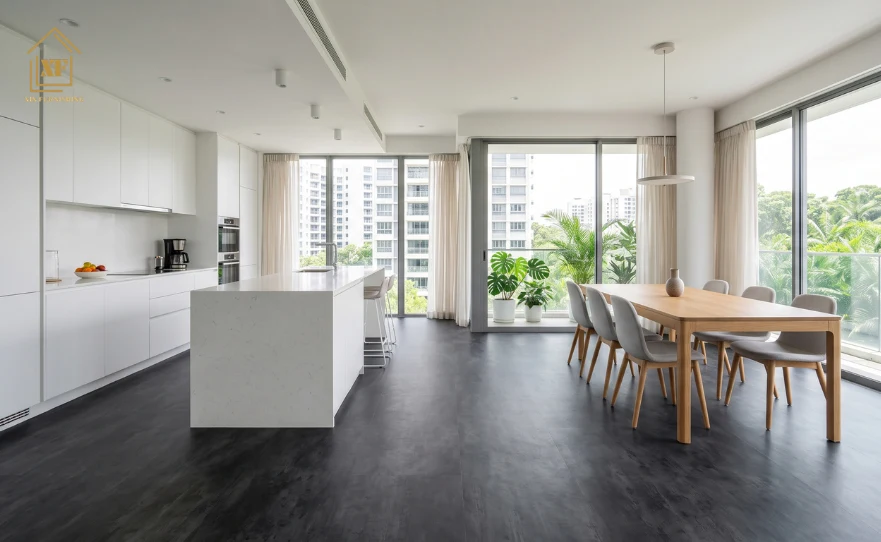
From standing height in a furnished room, yes. Close up, in raking light, you will see the joints.
How convincing it looks comes down to three things, and all three are choices you make, not product properties.
Tile size: Larger formats mean fewer joints across the floor. A 600 mm tile shows half the seams of a 300 mm one over the same area.
Joint treatment: Square-edged tiles butt together far more discreetly than bevelled ones. Bevels are designed to read as grout lines, which is exactly what you do not want here. On wood-look planks, a bevel helps; on a concrete look, it works against you.
Tonal variation: Real microcement has cloudy, irregular movement across the whole floor. Good vinyl reproduces that with multiple unique faces. Cheap vinyl repeats the same cloud pattern every few tiles, and on a plain surface that repeat is obvious in a way it never is on wood grain.
Get those three right and the floor reads as a continuous surface from normal viewing distance. Get them wrong, and it reads as tiles pretending to be concrete.
Real Microcement Flooring Vs Microcement Vinyl: What’s The Difference?
Worth understanding before you decide on the vinyl version, because the comparison isn’t close.
Microcement is a cement-based coating applied as a 2 to 3 mm overlay over an existing surface. A specialist applies it in multiple coats over several days, and then seals it. A microcement floor is a finished surface made on site, so no two installations look exactly the same.
People underestimate the resealing. A microcement floor is a maintenance commitment, and if the seal fails, the surface stains.
And it is not waterproof, which surprises most people. Sealed microcement resists water. It does not shrug it off the way a PVC plank does. In a humid climate like Singapore’s, where floors are mopped often and spills are routine, that seal does a lot of work and needs maintenance.
Cracking is the other difference. Hairline cracks are normal in a cement-based floor. Some people like them as part of the character. Others see them as a defect, and you can’t undo them without reapplying the coating. Vinyl does not crack.
If you want the material itself, with its cracks and its patina, microcement flooring is a legitimate choice. If you want the look, the vinyl version delivers it without the behaviour.
Microcement Flooring Pros And Cons
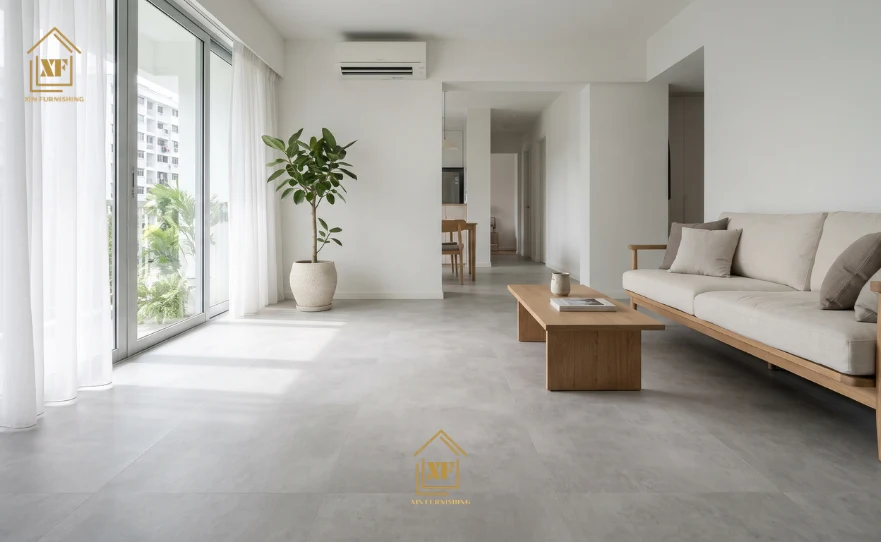
Here is how the two compare, side by side.
Microcement effect vinyl: pros
- Waterproof through the plank
- Installed in one day over sound existing tiles, with no hacking and no dust
- No resealing
- Repairs by swapping a tile
- Warmer and softer underfoot than cement
- S3.50toS8.00 per square foot supplied and installed
Microcement effect vinyl: cons
- Joints are visible up close, so it is not truly seamless
- Not suitable for Singapore bathrooms
- No hand-trowelled uniqueness, since the look is a print
- A design with few unique faces will show a repeat
Real microcement: pros
- Genuinely seamless, with a look that is unique to your floor
- Can be applied over existing surfaces, and to walls as well as floors
Real microcement: cons
- Multiple coats over several days, by a specialist
- Hairline cracking is characteristic
- Needs periodic resealing
- Water-resistant when sealed, not waterproof
- Hard and cool underfoot
- Difficult to repair, and patches show
- Considerably higher cost
Is There SPC Microcement Flooring?
Yes, microcement looks are made in SPC (rigid core) as well as in flexible LVT. Our microcement range is flexible LVT.
The core changes how the floor feels and behaves over the subfloor. It does not change how convincing the concrete look is. That depends on tile size, square edges, a matt finish and the number of unique faces, and you can specify all of those whichever core you choose.
Flexible has a slight give and stays warmer underfoot. Rigid core is stiffer. For most homes laid over existing sound tiles, flexible works well.
If you are weighing the two, our SPC vs LVT flooring guide compares them in full.
Tiles Or Planks: Which Format Suits A Concrete Look
This matters more for concrete than for any other design, because the whole aesthetic depends on continuity.
Large tiles work best. A 600 mm square tile in a concrete tone reads as a poured surface. We recommend this format for this look in almost every room.
Planks fight the aesthetic. A long, narrow plank announces itself as a plank. Concrete doesn’t come in boards, and the eye knows it even if it can’t say why.
Layout matters too. Lay large tiles in a straight grid rather than a staggered pattern. A brick-bond offset is a timber convention, and it reads wrong on concrete.
Our stone vinyl flooring range covers the tile formats that suit this look.
Microcement Colours And Finishes For Singapore Homes
Microcement tones are narrow by nature. That is the point of the look.
Light grey brightens a compact flat and makes a room feel larger. The most forgiving choice in an HDB unit with limited natural light.
Warm greige or putty softens the industrial edge. Suits homes where the concrete look might otherwise feel cold against timber furniture.
Deep charcoal anchors a large open-plan space. Dramatic, and it needs the room to carry it.
Always matt. A glossy concrete look is a contradiction, and it shows every footprint besides. Real microcement is sealed matt or satin, so gloss immediately breaks the illusion.
Our microcement series runs from light greys through to deeper tones, and the samples read very differently under daylight than under showroom lighting.
Which Rooms Suit Microcement Effect Vinyl Flooring
Works well in: living and dining rooms, hallways, studies, bedrooms (if you want a minimalist scheme), kitchens, and commercial spaces like offices, cafés, and showrooms where the look does real work.
Use with care: service yards. Splashes are fine; standing water is not.
Not in bathrooms. You will find suppliers recommending it, and Singapore competitors who say plainly that it is unsuitable for a wet bathroom here. They are right. A Singapore bathroom is laid with a gradient to a floor trap and soaked daily, so water reaches the joints and then the subfloor. Tiles remain the answer.
There is an irony here worth naming: microcement is most associated with seamless wet-room bathrooms, and that is the one room where neither the real thing nor the vinyl version belongs in a Singapore flat.
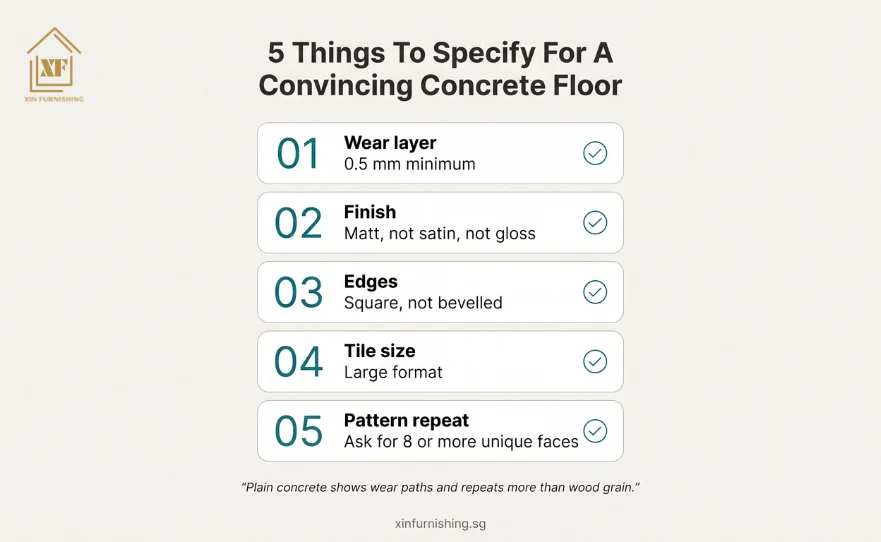
Five Things To Specify For A Convincing Concrete Floor
Three of these are specific to this look.
- Wear layer: 0.5 mm minimum. On a plain concrete surface, a worn traffic path shows far more clearly than on busy wood grain. No pattern to hide behind.
- Finish: matt. Not satin, not gloss.
- Edges: square, not bevelled. The bevel is what gives the game away.
- Tile size: large format. Fewer joints, more continuity.
- Pattern repeat: ask how many unique faces. This specification separates a convincing concrete floor from an obvious one, and almost nobody asks for it. Eight or more is reasonable.
Our guide covers how to assess vinyl flooring quality across every specification.
What Microcement Effect Vinyl Flooring Costs
It runs S$3.50 to S$8.00 per square foot supplied and installed, the same as any other vinyl design. The concrete print costs no more than a wood one.
Real microcement costs considerably more and carries ongoing maintenance. Published Singapore figures for a sealed screed or microcement finish sit well above the vinyl equivalent before you account for resealing every few years.
The bigger saving is in the works. Microcement needs the existing floor prepared and the specialist on site for days. Vinyl goes over your existing tiles in a day with no hacking, no dust and no permit complications.
Our vinyl flooring cost guide breaks down the full picture.
How To Care For A Microcement Vinyl Floor
Simpler than the real thing, which is most of the point.
- Sweep or vacuum regularly, since grit is what wears any floor
- Damp mop weekly with a pH-neutral cleaner
- Wipe spills promptly
- No steam, no abrasives, no wax or polish
One thing specific to this look: a matt concrete finish shows residue more than a textured wood grain does. Use less cleaner than the label suggests, and rinse if the floor feels tacky.
For the full routine, see our guide on maintaining microcement vinyl flooring. Our guides also cover how to clean vinyl floors and the best cleaning products for vinyl floors.
See The Microcement Range In Person
A postcard-sized sample tells you almost nothing about a concrete floor, because the whole look depends on continuity across a space.
Our Woodlands showroom has the microcement range laid out, so you can see how the tones read under real light and how the joints sit at scale.
WhatsApp +65 9690 2060 for a free site measurement.
FAQs
Will people be able to tell it isn’t real concrete?
Not from standing height in a furnished room, if you choose large square-edged tiles in a matt finish. Up close and in raking light, the joints are visible. That is true of every vinyl floor, and most people never look at a floor that way.
How do I avoid an obvious repeating pattern?
Ask how many unique faces the design carries. On a plain concrete surface, a repeat is far more visible than on wood grain because no busy pattern distracts the eye.
Is real microcement waterproof?
No. It is water-resistant when properly sealed, and the seal needs periodic renewal. Vinyl is waterproof through the plank with no sealing at all.
Can it go over my existing tiles?
Usually yes, if they are sound and reasonably level. That is the standard approach in a resale flat, and it avoids hacking entirely.
Does it feel cold like concrete?
No, and this is one of the clearer advantages. Real microcement is a cement surface and conducts heat away from your feet. Vinyl is PVC, which insulates, so it stays closer to room temperature.
Should I choose tiles or planks for a concrete look?
Tiles, in the largest format available. Concrete does not come in boards, and a plank format undermines the look even when the print is good.
Does it crack like real microcement?
No. Hairline cracking is characteristic of cement-based finishes and part of why some people like them. Vinyl does not crack.
Is SPC microcement flooring available?
Yes, microcement looks are made in both SPC (rigid core) and flexible LVT. Our microcement range is flexible LVT, which has a slight give and stays warmer underfoot. The core does not change how convincing the concrete look is. Tile size, square edges, a matt finish, and the number of unique faces do.
What are the pros and cons of microcement flooring?
Real microcement is seamless and unique, but it cracks, needs periodic resealing, is not waterproof, and costs considerably more. Microcement-effect vinyl is waterproof, installs in a day over existing tiles, needs no sealing, and costs S$3.50 to S$8.00 per square foot, but its joints show up close, and it doesn’t suit bathrooms.
Is microcement flooring suitable for Singapore homes?
The vinyl version suits living areas, bedrooms, kitchens, and hallways, and can be installed over existing tiles. Real microcement can work too, but it needs a specialist, several days on site and ongoing resealing, and neither version belongs in a Singapore bathroom.