Two suppliers quote you for vinyl flooring. One calls it LVT; the other calls it SPC. You have no idea whether you are comparing the same product or two different ones.
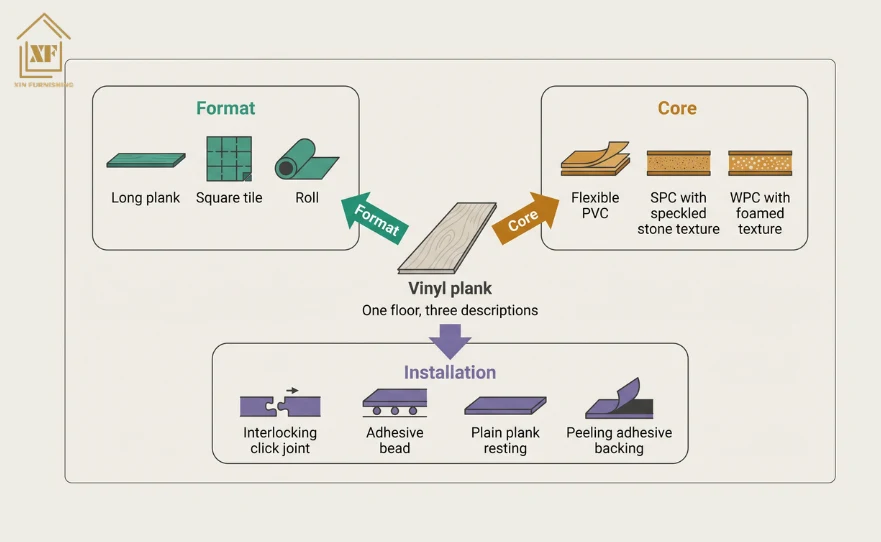
Usually, you are comparing the same product, described from different angles. Vinyl is classified in three ways: by shape, by core, and by installation method.
This guide explains what each means and which types to consider for a Singapore home.

The Three Ways Vinyl Flooring Is Classified
Every vinyl floor can be described three ways at once:
- By format: plank, tile, or sheet. The shape it comes in.
- By core: flexible, SPC or WPC. What is inside it, which decides how it feels and behaves.
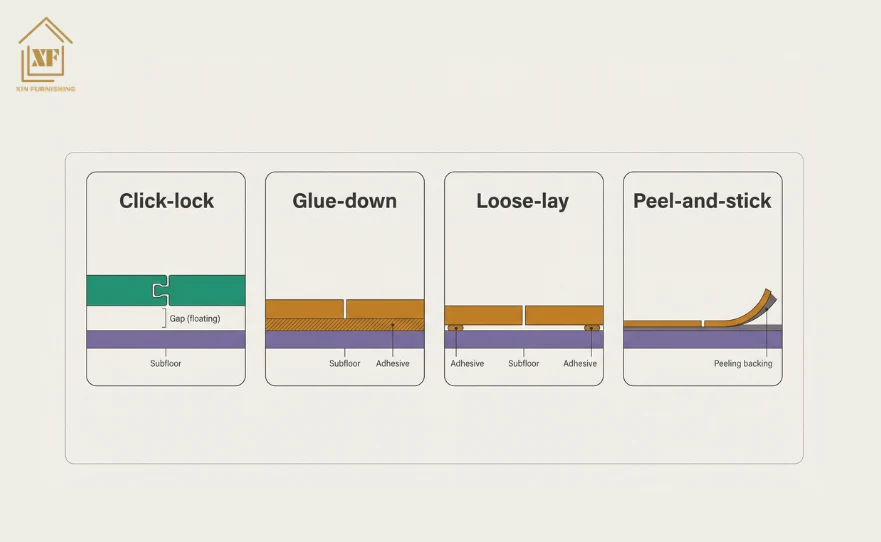
- By installation: click-lock, glue-down, loose-lay or peel-and-stick. How it attaches to your floor.
A single plank can be LVP by format, SPC by core and click-lock by installation. So a supplier quoting “LVT” is telling you the format, and one quoting “SPC” is telling you the core. They may well be describing the same product.
Types By Shape: Plank, Tile Or Sheet
Vinyl plank (LVP)
Long, narrow planks that mimic timber boards, usually around 180 mm wide and over a metre long. This is the most common format in Singapore homes.
Best for living rooms, bedrooms and anywhere you want a wood look. See our guide to Luxury vinyl plank flooring.
Vinyl tile (LVT)
Square or rectangular tiles, typically around 300 by 600 mm, used to mimic stone, marble, and concrete. Bevelled edges make the joints read as grout lines.
Best for kitchens, entryways and modern interiors. Our guide explains what LVT flooring is in full.
Sheet vinyl
Wide rolls, glued down for a seamless surface with almost no joints. Cheap, hygienic, and genuinely waterproof as a system, not just on the surface.
Used in clinics, commercial kitchens and laboratories rather than homes.
Types By Core: Flexible, SPC or WPC
Flexible core (LVT)
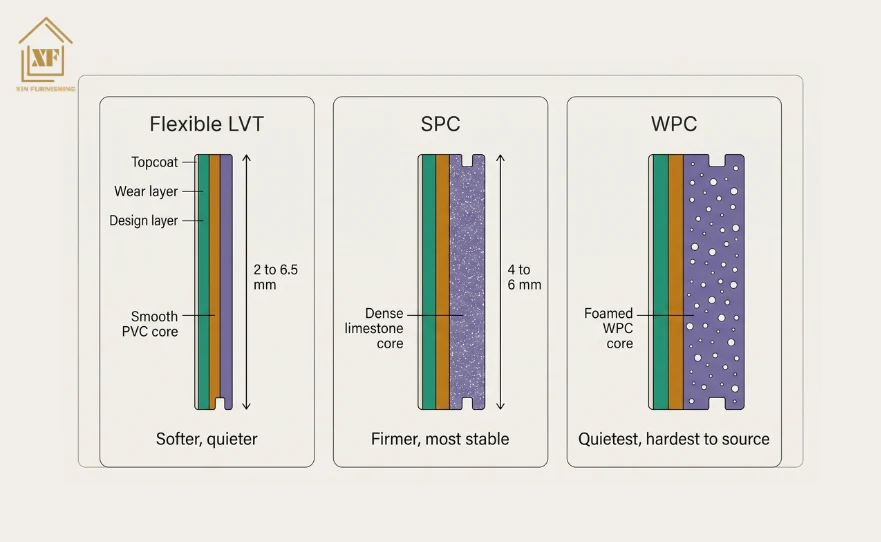
A flexible PVC core, typically 2 to 6.5 mm thick with a wear layer of 0.3 to 0.55 mm. Softer and warmer underfoot, better at absorbing footstep noise, and more forgiving of minor unevenness in older screed.
This is what we supply. Our guide covers what LVT flooring is and how it behaves in Singapore’s heat.
SPC (stone polymer composite)
A rigid core of limestone powder and PVC, typically 4 to 6 mm thick, with a 0.3 to 0.7 mm wear layer. Firmer and slightly noisier underfoot, but very stable through temperature swings.
Our guide compares SPC and LVT in detail, including where each one wins.
WPC (wood-plastic composite)
A foamed wood-plastic core, usually thicker than either. Quieter and warmer than SPC, more stable than a flexible core, and the best of the three acoustically.
Less common in Singapore and harder to source. Be careful with the word “hybrid”; some suppliers use it loosely. Always ask what the core is actually made of.
Whichever core you choose, treat 0.5 mm as your minimum wear layer. It decides how the floor looks after five years, and it is invisible in a showroom.
Types By Installation: Click, Glue, Loose-Lay Or Stick
Click-lock
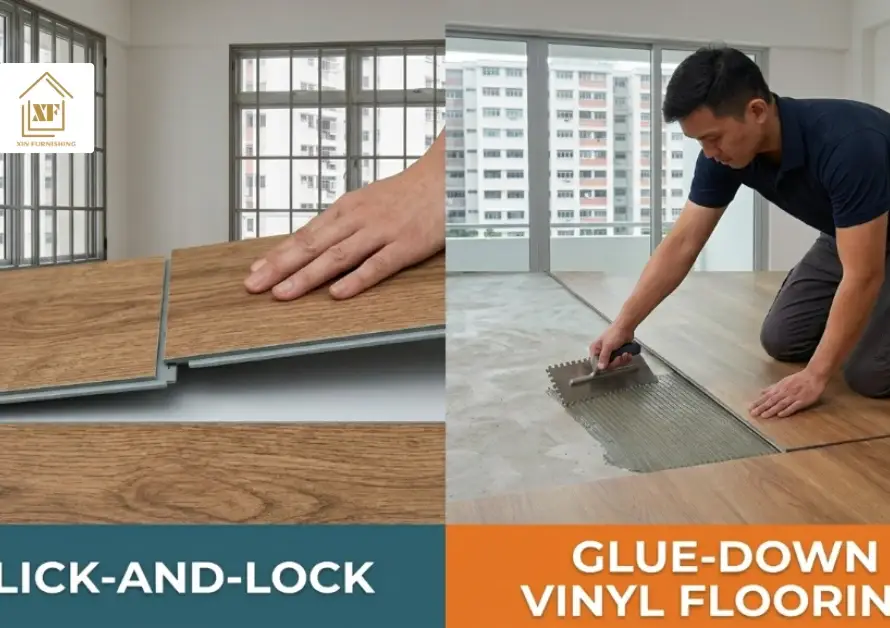
Planks lock together mechanically and float over the existing floor, with no adhesive. Most homes are finished in a day, and you can lift the floor later.
This is the standard method for HDB and condo overlays, and what we install. Our guide compares click-lock and glue-down.
Glue-down
Bonded to the subfloor with adhesive. It offers strong adhesion, suits large areas, and costs less in materials, which is why offices, retail units, clinics, and schools use it.
Trade-offs: It takes 24 to 48 hours to cure, and removal later is difficult without damaging the subfloor.
Loose-lay
Heavy planks held in place by friction and their own weight, sometimes with adhesive only at the edges. Easy to lift and reposition, but less stable underfoot. Uncommon in Singapore homes.
Peel-and-stick
Thin adhesive-backed tiles. The cheapest option, genuinely DIY-friendly, and popular with renters who want something removable in a small space.
It is a poor choice for a Singapore home, though. The adhesive struggles with constant heat and humidity, the tiles are too thin to last in a hallway, and they require a perfectly smooth subfloor to stick. For a rented room you will leave in a year, it has a place. For a flat you own, it does not.
How To Read A Quote Across All Three
Read any quote across all three columns. “LVT, flexible core, click-lock, 0.5 mm wear layer” tells you everything. “Vinyl flooring” tells you almost nothing.
Which Type Is Most Popular In Singapore?
It depends on who you ask and what they want.
SPC leads the overall market, and most suppliers will tell you so. Its rigid core handles heavy traffic and stays dimensionally stable as a room swings between air-conditioning and afternoon heat. For offices, retail units and rental properties, it is the default.
Flexible-core LVT leads in bedrooms and living rooms, where comfort and quiet matter more than traffic resistance. It is softer and warmer underfoot, and it absorbs footstep noise better, which matters in high-rise living.
Click-lock is the dominant installation method in homes because it avoids hacking by overlaying existing tiles.
We specialise in flexible-core LVT rather than carrying both. As a direct vinyl flooring supplier in Singapore, we keep one range properly stocked rather than spreading across two.
Which Types You Will Actually Find In Singapore
Not every type on this page is a realistic option in Singapore.
Common: click-lock planks and tiles with flexible or SPC cores. This covers most residential installations.
Occasional: glue-down for commercial work, and sheet vinyl for clinics and food preparation areas.
Rare, and usually best avoided at home: loose-lay, peel-and-stick, and WPC, which is harder to source locally.
If a supplier is pushing peel-and-stick for an HDB flat, that says a lot about the supplier.
Residential And Commercial Applications

For homes, the usual specification is a click-lock plank or tile with a 0.5 mm wear layer, laid over existing tiles. HDB flats, condos and landed homes all take the same approach. Flexible cores suit bedrooms and living rooms; rigid cores suit unconditioned rooms and heavy furniture.
For commercial spaces, the specification changes. Offices, retail units, and cafés need a heavier wear layer for traffic, and large open areas often use glue-down instead of click-lock. Clinics, laboratories, and commercial kitchens usually use sheet vinyl because a seamless floor with coved edges is easier to sanitise.
Our guide to commercial vinyl flooring covers what to specify.
Frequently Asked Questions
What are the main types of vinyl flooring?
By format: plank, tile and sheet. By core: flexible, SPC and WPC. By installation: click-lock, glue-down, loose-lay and peel-and-stick. Any single floor is described by all three.
What is the difference between LVT and LVP?
Format only. LVP is plank-shaped, usually for timber looks. LVT is tile-shaped, usually for stone- and marble-look designs. The construction is the same, and many suppliers use LVT as the umbrella term for both.
Which type of vinyl flooring is best?
For most Singapore homes, a click-lock plank or tile with a 0.5 mm wear layer. The core is the real decision: flexible for comfort and quiet, SPC for rooms that heat up and cool down daily.
What thickness should I choose?
Most residential vinyl ranges from 4 to 6.5 mm. Thicker planks feel more solid and often carry a built-in underlay, but they add height at your doorways. The wear layer matters more than the total thickness.
Is SPC better than LVT?
Neither is better overall. SPC is more heat-stable and resists denting; LVT is softer, warmer, and quieter.
Are all types of vinyl flooring waterproof?
The plank surface is waterproof on all of them. That is different from a waterproof floor system, which is why bathrooms are still tiled regardless of type.
Which type is cheapest?
Peel-and-stick, then sheet vinyl, though neither suits a Singapore home well. Among realistic options, a thinner wear layer costs less upfront, but you pay for it later. See our vinyl flooring cost guide.